


Note: This is a distilled, rapid-fire version of my full essay on AI in IBD - Silencing The Noise. If you are heading to Stockholm for ECCO this week, this is the briefing you need before the congress starts.
The Conversation We Are Not Having
My biggest concern is not that AI will replace doctors - it won’t. It is that most doctors have no idea what is coming.
At medical congresses like ECCO, we tend to hear two types of AI talk. One is the “clinician update,” often out of date and focused on surface-level chatbots. The other is the “technical deep dive,” a niche presentation on histological scoring algorithms that feels abstract to clinical practice.
Both miss the point. We are ignoring the massive middle ground: what happens when the entire operating system of medicine encounters intelligence this powerful, this fast?
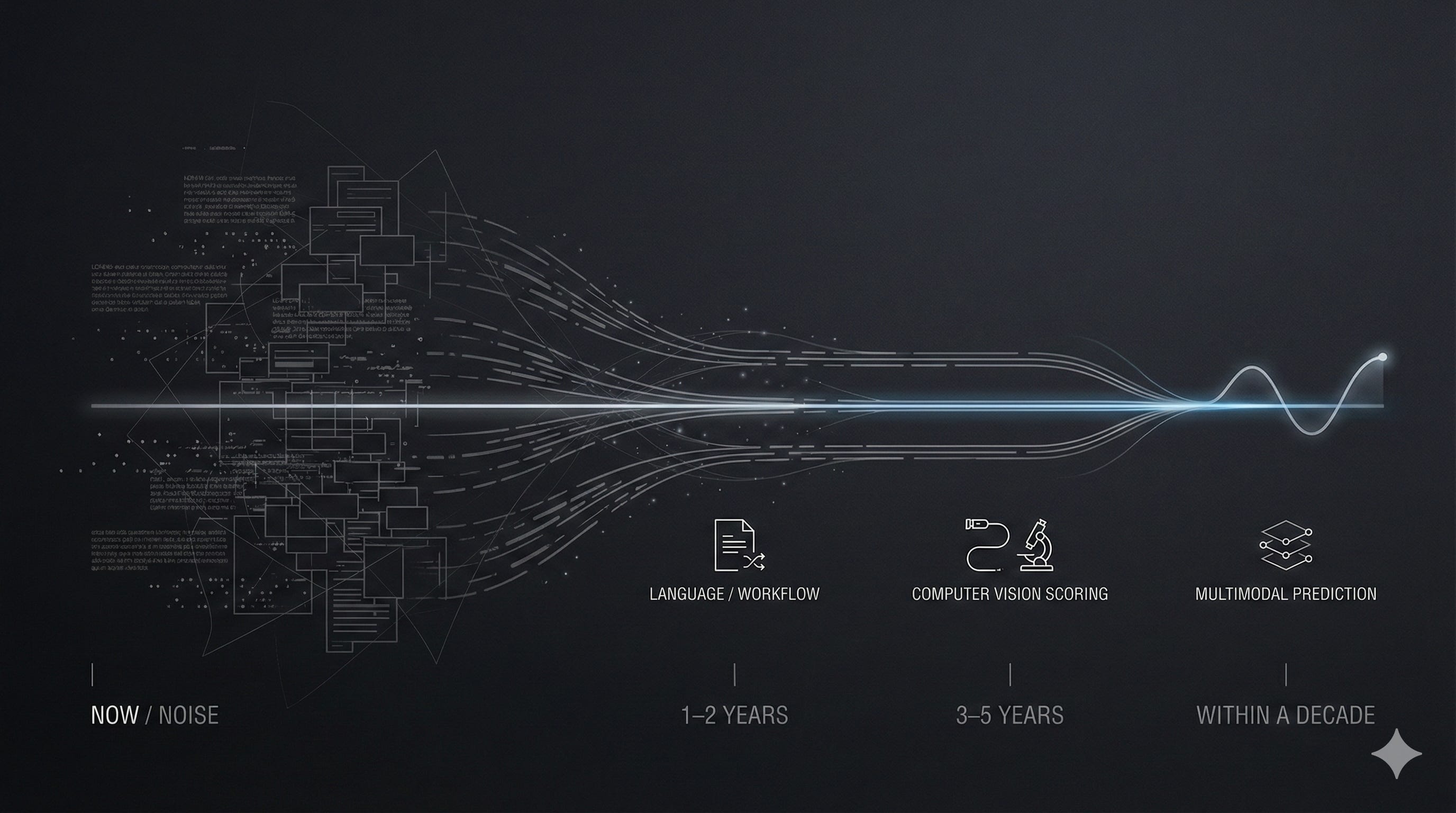
The Problem: We Are Drowning
I open a patient record in clinic and watch the scroll bar sink to a sliver. Ten years of letters. Unstructured. Unindexed. A folder of PDFs and pasted text with no map.
The arithmetic of IBD care is broken. Prevalence is heading toward 1%, but capacity is stagnant. We cannot hire our way out of this.
We have better drugs than ever, but the gap between what is possible and what is delivered remains vast. Why? Because IBD is a disease of longitudinal patterns, yet we treat it in snapshots. We treat in crisis because the signals were buried on page six of the document repository.
The Solution: Three Layers of Intelligence
“AI” is not just chatbots.
For IBD, it is three distinct tools to solve three distinct problems.
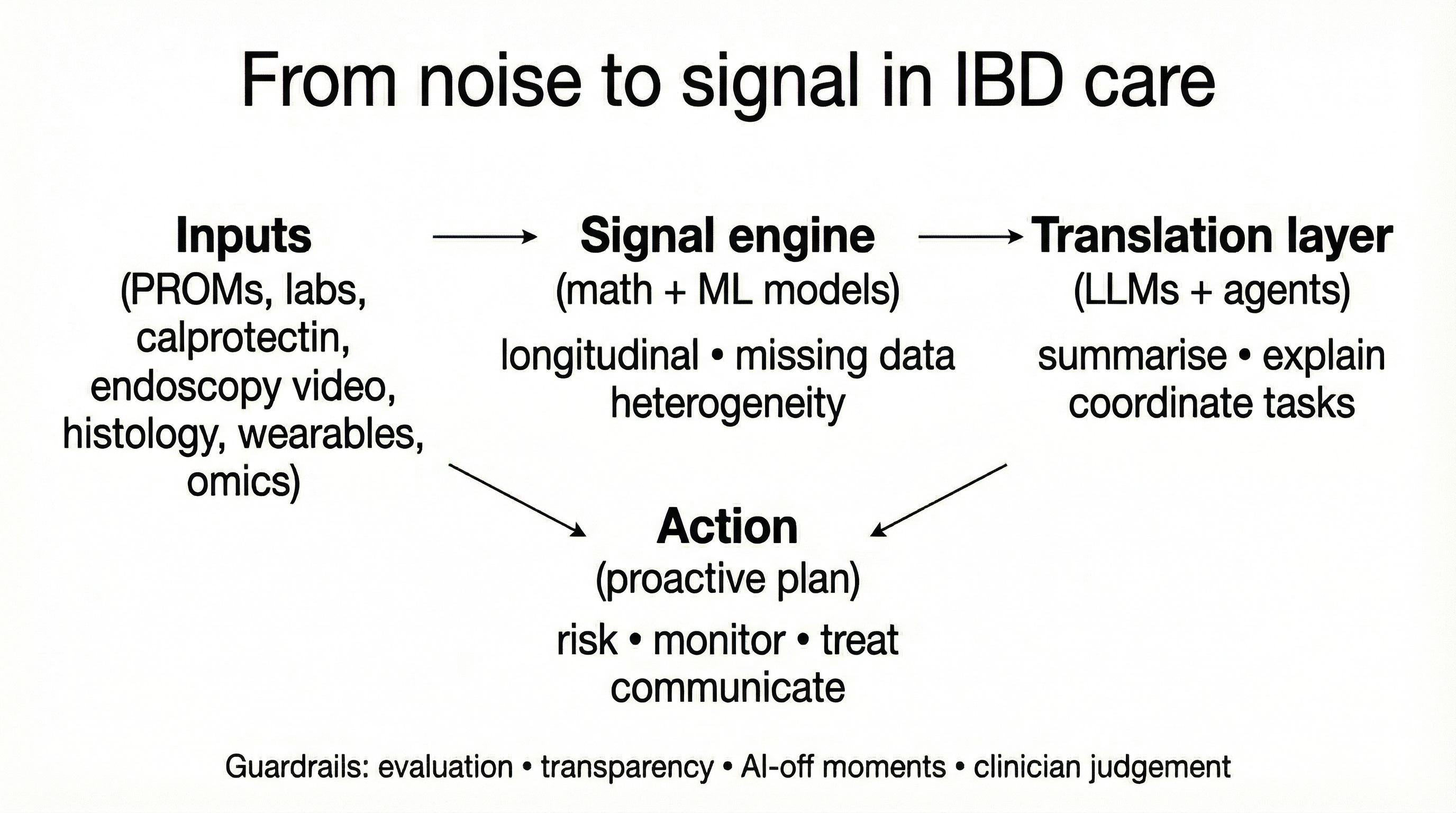
1. Language Models: Turning text into structure
Medicine lives in words. Diagnosis dates, phenotypes, and histories are trapped in unstructured letters.
The unlock: LLMs can summarise histories, draft referrals, and structure data instantly.
The evidence: Randomised trials are already showing LLMs can reduce specialist consultation time by nearly 30% while improving care coordination.
2. Computer Vision: Making scoring objective
We still rely on subjective human assessment for our hardest endpoints.
The unlock: Converting endoscopy, histology, and MRI into objective, reproducible data.
The evidence: AI scoring of ulcerative colitis video is now predicting outcomes better than the Mayo score. In capsule endoscopy, AI reads can cut review time to four minutes while increasing sensitivity to >94%.
3. Predictive Models: Treating trajectories, not snapshots
Language models predict words, not biological trajectories. That requires maths.
The unlock: Systems that ingest routine biomarkers (CRP, calprotectin) and map patients onto dynamic risk trajectories.
The Action: In Edinburgh, we are launching a pilot of SENTINEL in March: a system that updates risk every time a blood result lands, flagging the patients who are drifting off course before they flare.
The Risk: The “Deskilling” Trap
Capability is not reliability. The most dangerous failures in medicine are the ones that look confident.
We must be honest about the risk of “deskilling.” Recent data suggests that endoscopists who rely on AI for polyp detection may see their own detection rates drop when the AI is removed.
We are building SENTINEL with a “human-in-the-loop” precisely for this reason. AI should quiet the noise, not replace the signal.
The Timeline
1-2 Years: Ambient documentation and AI-generated summaries are standard.
3-5 Years: Decision support tools like SENTINEL are in major centres.
10 Years: Multimodal prediction (genomics + imaging + biomarkers) guides population health.
Enjoy ECCO. If you see me there, let’s talk about how we build this safely.