


2025 was the Great Remodelling. JAKs and IL-23s moved up the board. We stopped pretending “one size fits all” was a strategy.
2026 is different. It’s not about another crowded mechanism. It’s about proof: that we can go deeper, go safer, go faster, and still deliver it in real clinics with real capacity constraints.
Not “what works?” but what lasts, what scales, and what changes outcomes.
The 2026 dashboard
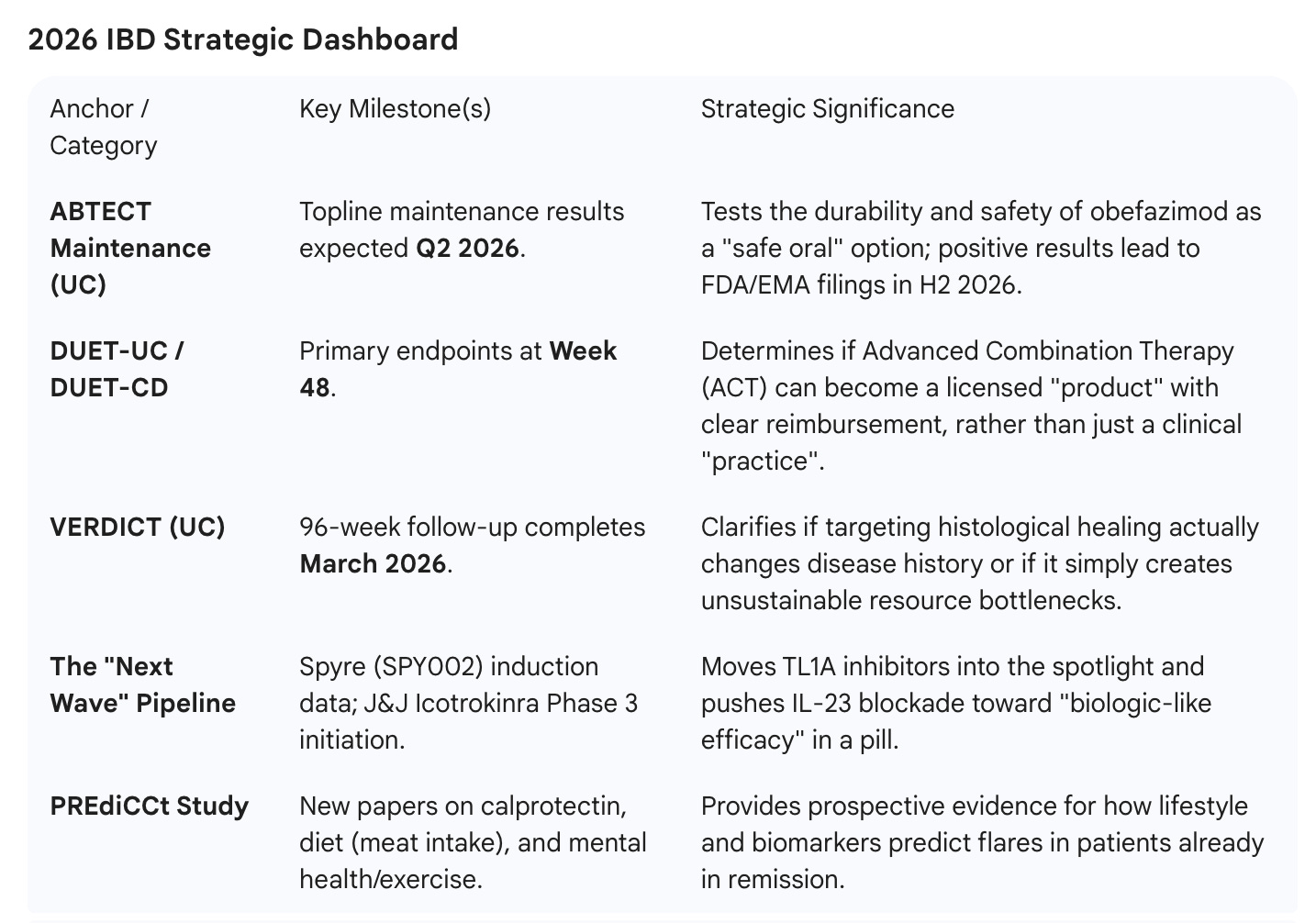
Three readouts will define the year.
ABTECT maintenance (UC): Does obefazimod hold? Topline expected Q2 2026.
DUET-UC / DUET-CD: Does advanced combination therapy get its first rubber stamp? Primary endpoints at Week 48.
VERDICT: Will treat-to-target finally tell us how deep “deep” needs to be? UK 96-week follow-up completes March 2026.
Everything else matters too, but these are the anchors.
1. ABTECT maintenance: the “safe oral” bet gets its verdict
The story so far is clean.
In July 2025, Abivax reported positive Phase 3 induction results from ABTECT-1 and ABTECT-2 in moderate-to-severely active UC. The 50mg once-daily dose met primary and key secondary endpoints in a large, globally representative programme.
But induction is the trailer. Maintenance is the film.
What we’re watching for
Topline maintenance results expected Q2 2026. The questions are simple:
Durability: Does the signal persist across a year?
Safety: Does it stay boring? (Boring is good.)
Positioning: Does it become an oral option for all lines of therapy?
Abivax has been explicit: if maintenance is positive, they plan to submit for FDA/EMA filings in H2 2026. That makes this the year of the data, not the year of the drug on shelves.
I wonder if we also see a major pharma acquisition next year?
2. DUET-UC / DUET-CD: can combination therapy break the ceiling?
If ABTECT is about a new therapy, DUET is about combining existing drugs.
The DUET programme tests a fixed combination of guselkumab + golimumab against monotherapy and placebo in UC and Crohn’s. The trial design tells you what Janssen thinks the problem is: not “we need another monotherapy” but “we need to stop pretending monotherapy is enough for everyone.”
DUET-UC (Phase 2, 577 participants) includes guselkumab, golimumab, and combination arms. DUET-CD has Week 48 primary endpoints with clinical remission and endoscopic response, plus an optional long-term extension.
The real question: is ACT (advanced Combination Therapy) a concept or a category?
Combination therapy has been slowly shifting from “wild idea” to “quiet reality,” particularly in refractory disease. But it’s still treated as exceptional, expensive, risky, hard to justify.
A positive DUET signal would be the first genuine rubber stamp for ACT as a category. Not just a clever case report.
If DUET hits, it won’t just be a result. It will be a permission structure.
Can we start already?
This is the uncomfortable bit.
If the combination is licensed, it becomes legible to payers, guidelines, and governance. If not, we’re stuck where clinicians improvise, systems resist, and patients experience postcode biology.
There are two possible futures:
Future A: combo becomes a product. DUET’s co-formulated combination pushes us toward a world where companies make ACT easy. One injection, one label, one reimbursement pathway.
Future B: combo becomes a practice. The biosimilar era makes combination therapy harder to ignore. People will ask whether low-cost pairs could deliver most of the benefit. The obvious thought experiment: biosimilar ustekinumab + biosimilar adalimumab.
But a plausible idea is not evidence. A cheap idea is not automatically a safe idea.
If DUET is positive, the right next step isn’t “everyone start mixing biologics.” It’s: build the trials and systems that make ACT safe, scalable, and equitable.
If DUET is negative? Still progress. It tells us that “more blockade” isn’t automatically “more healing” … or less dramatically that gus + goli is the wrong combination.
Either way, the field learns.
3. VERDICT: defining the target, not just chasing it
VERDICT is one of the most strategically important trials running in IBD.
It randomises patients with active UC to different treatment targets:
Corticosteroid-free symptomatic remission
Symptomatic + endoscopic remission
Symptomatic + endoscopic + histologic remission
Funded through Takeda, using a structured algorithm with vedolizumab as the core escalation pathway, it’s trying to answer the question the field keeps circling:
Does deliberately pushing all the way to histological healing change the natural history?
We have interim analyses to Week 48, and a clear anchor: 96-week follow-up completes 2026; results hopefully at UEG in Barcelona.
The implication is operational, not ideological
VERDICT isn’t just an important data gap, nor just a philosophical argument about histology. It’s a resource question.
If histology meaningfully reduces complications:
Biopsies become routine targets, not optional extras
Colonoscopy (and pathology) capacity becomes a bottleneck
AI-enabled standardisation becomes necessary
Treat-to-target becomes even more demanding
If histology doesn’t add value beyond endoscopic remission:
We stop over-measuring and over-treating
We simplify targets without lowering ambition
Either outcome is clarifying. Clarity is rare.
The next wave gathering steam
The headline readouts matter. But the real work of 2026 is that the pipeline keeps laying track. Three threads to watch. Not because they’ll finish in 2026, but because they become unavoidable.
TL1A: the class that refuses to be ignored
Merck has stated that tulisokibart is in Phase 3 trials for UC and Crohn’s, while expanding into other immune-mediated diseases. TL1A is no longer “interesting biology.” It’s an industrial-scale bet.
Then there’s Spyre. SPY002 is a half-life-extended anti-TL1A antibody, now in the Phase 2 SKYLINE-UC platform trial. Spyre has guided that induction data are expected in 2026.
That’s the kind of milestone that changes the feel of a class.
Oral IL-23 receptor blockade: icotrokinra is the one to watch
J&J has initiated ICONIC-UC Phase 3 (adults and adolescents) and ICONIC-CD Phase 2b/3 following Phase 2b ANTHEM-UC results.
This matters because it pushes the IL-23 axis toward the holy grail: biologic-like efficacy, pill-like scalability.
Even without Phase 3 readouts in 2026, the implications start now: recruitment pace, trial design choices, and the first credible signs of gut translation at scale.
Other 2026 highlights
The Lancet Commission on Global IBD
ECCO has flagged the official launch at ECCO’26 (Stockholm, Feb 18-21, 2026).
The epidemiology is no longer a background slide. It is the story.
PREdiCCt: from signals to full manuscripts
PREdiCCt has been ten years of my life.
A UK prospective study of 2,629 people with IBD in remission (47 NHS centres, 2016–2020; median follow-up just over four years). The first paper, accepted in GUT and due online imminently, shows baseline faecal calprotectin predicts objective flares even when patients feel well (in UC, about 11% vs 34% two-year risk across low vs high calprotectin).
It also finds a UC-specific association between higher meat intake and roughly double objective-flare risk, not seen in Crohn’s.
The second PREdiCCt paper, presented at ECCO 2025, moves away from diet and looks at behavioural and mental health predictors. The key finding is that in ulcerative colitis, depression and lack of exercise predict objective flares. This is not a “mind over matter” story; it is a signal that these factors belong in relapse-risk assessment, alongside biomarkers.
There is also a major multi-omics layer coming.
We now have 2,000 gut metagenomes fully sequenced, through QC, and moving towards analysis. That should let us test how microbiome features interact with baseline inflammation, diet and behaviour in predicting relapse, using prospective follow-up rather than retrospective associations.
What to expect on the ground
This is the part we talk about least. It isn’t glamorous. But it’s the real constraint.
More patients. Everywhere.
IBD has a compounding problem: once prevalence is high, it stays high because people live with the disease for decades. Meanwhile, incidence is accelerating globally.
A recent Nature review (see part two) describes the global evolution across epidemiological stages. The forward-look literature is blunt: the burden is rising through 2025-2045.
More patients, more complexity, more therapy lines, more monitoring, more contact points.
Treat-to-target becomes the default
The field has agreed on the principle. VERDICT is testing the depth.
Whichever way VERDICT lands, the direction is obvious: more calprotectin, more scopes, more biopsies, more imaging, more treatment adjustments, more documentation, more shared decision-making.
It’s not “extra.” It’s the job.
And it will stress systems built for a lower-prevalence era. This is where monitoring systems and workflows that scale stop being a shiny add-on and become basic infrastructure.
A tidal wave of comparative effectiveness and RWE
It’s coming.
As the therapeutic menu expands, we’ll see pragmatic head-to-heads, registry comparisons, payer-driven analyses, biologic class positioning studies, safety-focused real-world datasets.
Useful. But they won’t deliver the one thing everyone asks for.
Don’t expect RWE to hand you “the” sequencing answer.
Because sequencing isn’t one question. It’s fifty questions, each conditional on phenotype, risk, prior exposure, time horizon, patient preference, and system capacity.
RWE will help with durability patterns, safety in broader populations, what happens outside pristine trial protocols.
RWE will not reliably answer: what you should do next in this patient, what you should have done first, what the counterfactual would have been.
Sequencing will remain a clinical craft. Increasingly informed, but never fully automated.
Closing
If 2025 was the year we rebuilt the therapeutic map, 2026 is the year we test whether that map can guide us somewhere better.
ABTECT maintenance asks if a new oral mechanism can be durable and boring-safe.
DUET asks if ACT can truly break the ceiling, and if it can, whether we can afford to ignore it.
VERDICT asks what treat-to-target really means when you follow it all the way down to histology.
And underneath: more IBD, more everywhere, and a care model that has to evolve as fast as the science.
2026 won’t be a victory lap. It will be a year of consequences.
That’s a good thing.