


This is the first of two pieces on combination therapy in IBD. It covers two advanced therapies given together, mainly as injections: where the evidence stands, why a two-in-one injection is hard to make and to prove, the two big readouts from DDW and UEG this year, and what comes next. Part 2 will cover oral combinations, and injections paired with tablets.
New — EdinburghIBD.com is now live: We have just launched the new digital home for our integrated research and clinical programme at the University of Edinburgh and NHS Lothian, covering our SENTINEL platform, PREdiCCt, the Lothian IBD Registry, and 10 recruiting trials. More details at the bottom of this post.
Eight years ago I had the idea of combining ustekinumab and vedolizumab after anti-TNF failure in Crohn’s disease. Each drug alone only went so far. Would the two together do better? I should have run that study. Of course, no one would have funded it back then.
In 2022, at DDW in San Diego, Nick Powell and I came very close to persuading Celltrion to fund a trial of subcutaneous infliximab plus ustekinumab. Celltrion already made subcutaneous infliximab, and its own ustekinumab biosimilar was on the way. That would have been pretty cool. It didn’t happen. Someone is now testing that pair, though: COMBO-UC, a publicly funded trial in Lodz, is randomising people with UC to infliximab (IV in this case), ustekinumab or both. It reads out in 2028.
Four years on, the idea has gone mainstream. J&J, AbbVie and Spyre are all building pairs of antibodies for IBD, and this year we got the first large randomised data. So it’s a good moment to ask the obvious question. Do two advanced therapies beat one?
A word on scope. By combination therapy I mean two advanced therapies at once, not an advanced therapy plus a thiopurine. That older combination works: in SONIC and UC SUCCESS, infliximab plus azathioprine beat infliximab alone. But much of that gain came from azathioprine damping down antibodies to infliximab and keeping drug levels up. Pairing two modern advanced therapies is a different question, and the gain has to come from the biology.
The answer so far
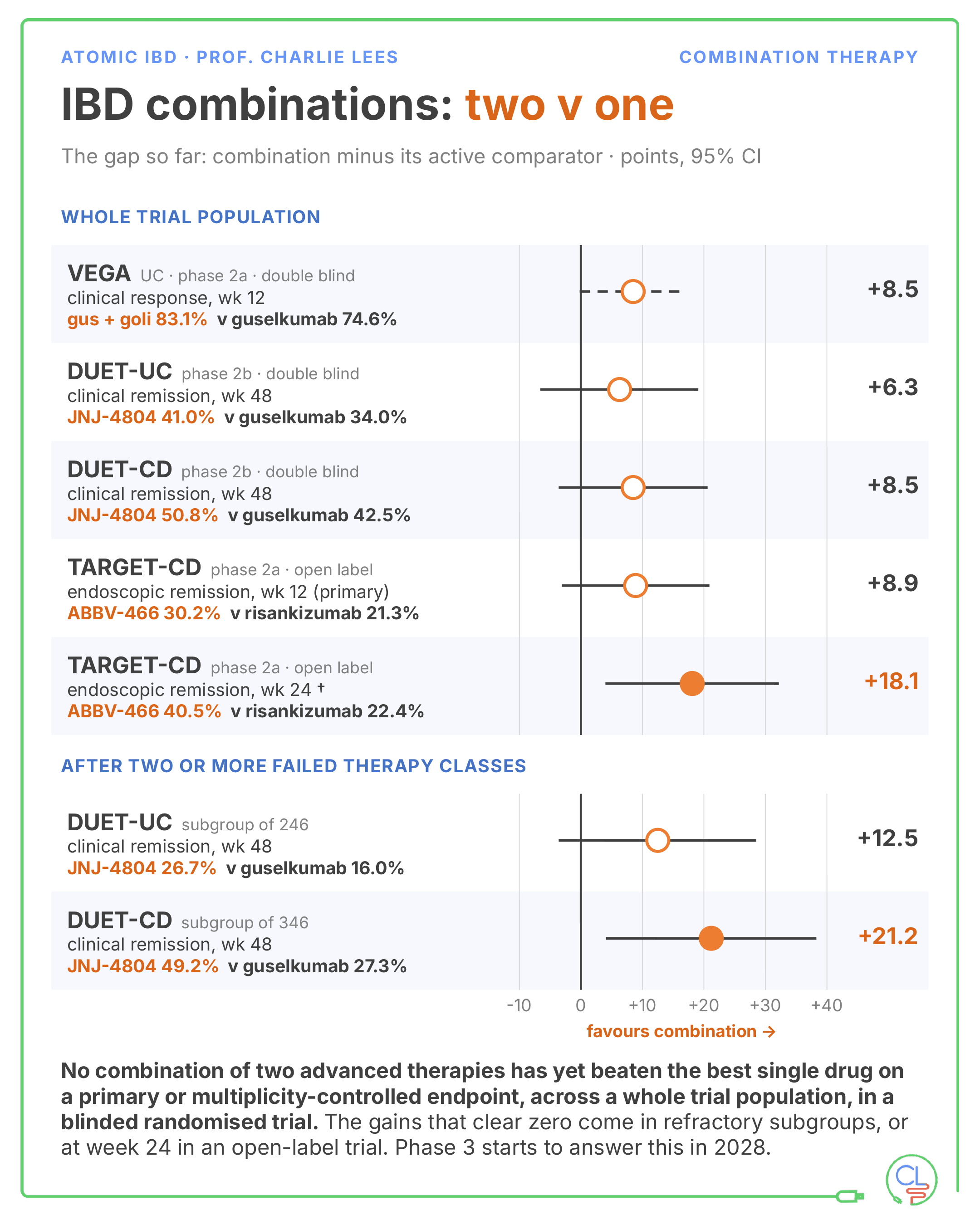
Every estimate in figure 1 leans towards the combination. But no combination of two advanced therapies has yet beaten the best single drug on a primary or multiplicity-controlled endpoint, across a whole trial population, in a blinded randomised trial. The gains that clear zero come in refractory subgroups, or at week 24 in an open-label trial.
Beating placebo, or beating the weaker partner, tells you very little. A combination has to beat the best single drug, because that is what we would otherwise give.
The earliest hint came from VEGA in UC. Its secondary remission endpoints favoured the combination, and the gap over guselkumab held to week 38 (44% against 31%), 26 weeks after golimumab had stopped. But VEGA was intentionally small and exploratory, and its primary endpoint against guselkumab wasn’t met.
Why a two-in-one injection is hard
Regulators treat a two-in-one injection as a new medicine, even when both antibodies are already licensed. Getting it co-formulated properly, at the right dose and the right interval, and then showing it beats the best single drug, takes rigorous evidence. That evidence has to satisfy the FDA, the EMA and the MHRA, and then clinicians and the community. There are five hurdles.
Formulation. Both antibodies have to stay stable together, at high concentration, in a volume an autoinjector can deliver. So far only J&J’s JNJ-4804 is given as one subcutaneous injection from week 0. In TARGET-CD both drugs were given intravenously for induction, then subcutaneously. AbbVie hasn’t yet said publicly whether ABBV-466 is a single co-formulated product, but giving the pair its own name and taking it forward at two doses in the new platform study suggest that’s where it’s heading.
Dose. With a fixed ratio you can’t push one drug without pushing the other, so the pair needs its own dose-finding. DUET shows why. In UC, the low and mid doses of JNJ-4804 came in below guselkumab alone (22% and 27% against 34%), and only the high dose came out ahead.
Interval. The two half-lives have to line up, or one drug runs out before the other. Spyre has engineered half-life extension into all three of its antibodies, aiming for dosing every three to six months.
Contribution. Regulators want to see that each drug pulls its weight (see the FDA and EMA guidance). That usually means a factorial design, where the pair is tested against each component. Spyre’s SKYLINE-UC is doing exactly that, testing each pair against each of its parts and against placebo, with data due in 2027.
Persuasion. Then there’s the rest of us. Clinicians, patients and payers will want a gain that holds across endpoints, lasts, is safe and is worth paying for, increasingly against cheaper biosimilars.
Box 1. Other fields got there first
Oncology has licensed two-antibody combinations by two routes. Opdualag, nivolumab co-formulated with the new anti-LAG-3 antibody relatlimab, was approved in melanoma in 2022 after a double-blind phase 2/3 trial against nivolumab alone (RELATIVITY-047), with median progression-free survival of 10.1 months against 4.6. That’s the test DUET ENCORE now sets JNJ-4804. Phesgo, pertuzumab and trastuzumab in one subcutaneous injection, took the other route. The pair had already been proven as two infusions, so its approval in 2020 rested mainly on showing that drug levels matched (FeDeriCa). That’s the route an infliximab plus ustekinumab injection would need: prove the pair first, then put it in one device.
Rheumatology is the cautionary tale. Adding anakinra to etanercept in rheumatoid arthritis brought more serious infections and no extra benefit, and it put many people off pairing biologics in immune disease. As far as I know, no two-antibody combination has yet been licensed in any immune-mediated disease, so IBD is ahead of the curve here.
In IBD we aren’t there yet. But the great news is it’s coming, and the two trials that reported this year show both the upside and the design trade-offs.
DUET: two antibodies in one injection
DUET tests JNJ-4804, J&J’s guselkumab plus golimumab given together in one subcutaneous injection, in two phase 2b trials, one in UC and one in Crohn’s disease. The main results were at DDW in May, with more on the most refractory patients at UEG this month.
At week 48, high-dose JNJ-4804 beat golimumab in both diseases. Against guselkumab, clinical remission was 41% v 34% in UC and 51% v 43% in CD, differences that were not statistically significant.


The bigger differences came in patients who had already failed two or more therapy classes, about half of each trial. In CD, 49% were in clinical remission on the high dose v 27% on guselkumab. In UC it was 27% (12 of 45) v 16% (8 of 50) on guselkumab and 2% (1 of 47) on golimumab. These are exploratory subgroup analyses with wide confidence intervals.
On safety, serious adverse events to week 48 were highest on placebo and golimumab, the arms with the least disease control. That is in line with the placebo-harms meta-analyses of induction and maintenance trials published in Lancet Gastroenterology & Hepatology in 2024.
One design detail matters for reading week 48: people who weren’t responding at week 24 were moved onto JNJ-4804, so it isn’t a pure arm-by-arm comparison.
The phase 3 trials, DUET ENCORE, compare JNJ-4804 with guselkumab alone in 644 people with UC and 460 with CD, with primary completion estimated for mid 2028.
As with many of these big, complex and important trials, the full papers will provide critical details and analyses not easily found in the public domain at the moment, and help show where this approach might fit.
TARGET-CD: IL-23 plus α4β7
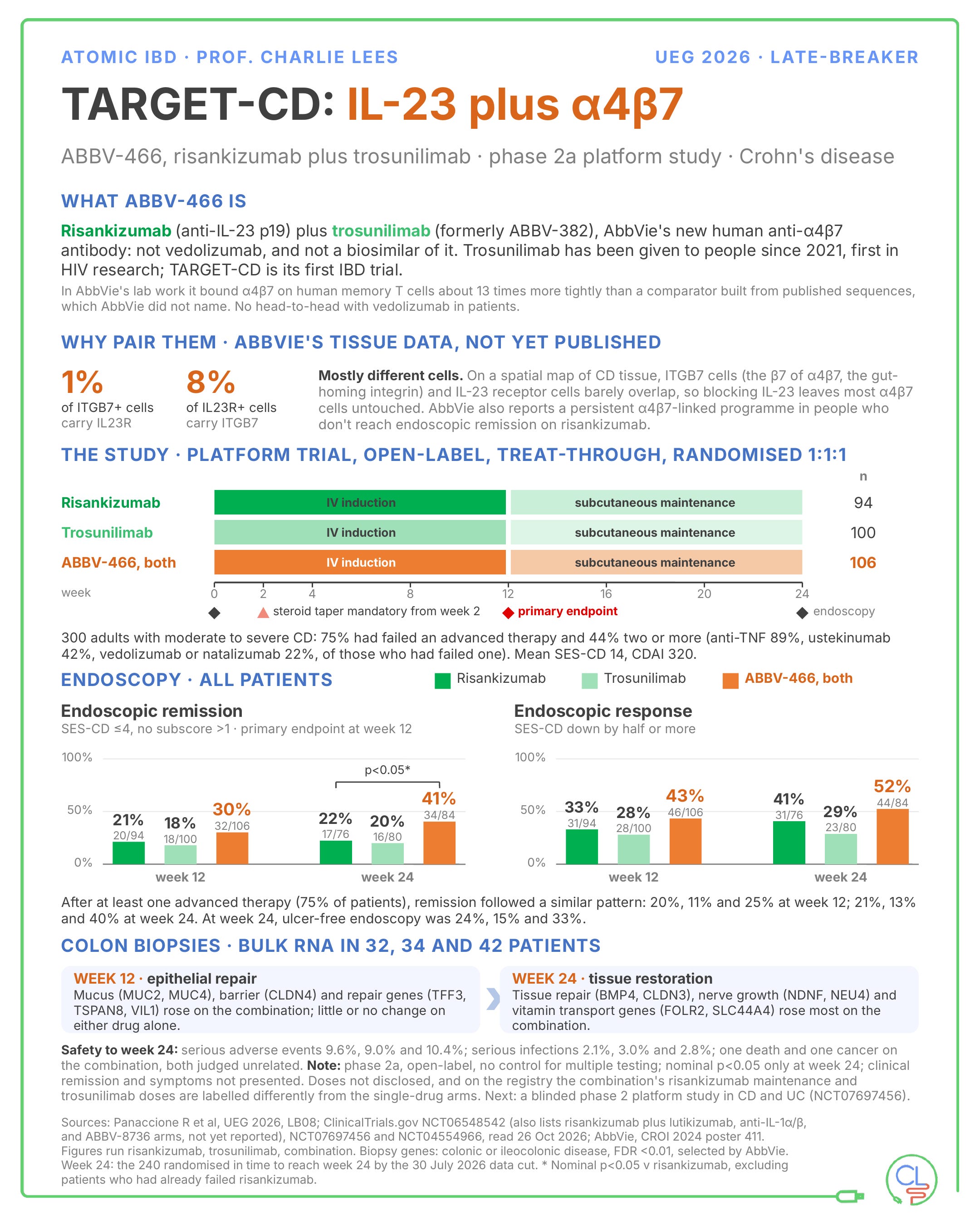
At UEG Week, Remo Panaccione presented the first data on ABBV-466, AbbVie’s combination of risankizumab with trosunilimab, a new anti-α4β7 antibody.
Trosunilimab isn’t vedolizumab, and it isn’t a biosimilar of it. It’s a new human antibody that AbbVie first developed for HIV research. In their lab work it binds α4β7 about 13 times more tightly than a comparator built from published sequences.
So α4β7 is back as a target in Crohn’s disease, this time as a partner for IL-23 blockade.
AbbVie’s tissue data, not yet published, show why that might work. In CD tissue, the IL-23 receptor and α4β7 sit on mostly different cells. Risankizumab alone leaves most of the gut-homing cells untouched.
The trial was part of the TARGET-CD platform study. It took 300 adults with moderate to severe CD, and three quarters had already failed an advanced therapy. They were randomised to risankizumab, trosunilimab or both (ABBV-466).
Endoscopic remission at week 12 was 30% on the combination, against 21% and 18% on each drug alone. By week 24, in the 240 randomised early enough to reach it by the data cut, it was 41% against 22% and 20%. The combination almost doubled the rate and was still climbing, while each drug alone had levelled off. By week 24, more than half on the combination had an endoscopic response. The pattern held in people who had already failed an advanced therapy: 40% against 21% and 13% at week 24.
Early transcriptomics from small biopsy subsets look interesting too. Epithelial repair and barrier genes rose by week 12, and tissue repair, nerve growth and vitamin transport genes by week 24, mainly on the combination.
Safety looked similar across the three arms. There was one death and one cancer on the combination, both judged unrelated by the investigators.
It’s phase 2a and open-label. The only p-value is nominal, at week 24. Clinical remission wasn’t presented, and the doses haven’t been disclosed. But AbbVie is already running a blinded phase 2 platform study in around 2,000 people with CD and UC, which includes ABBV-466 at two doses. The harder test is under way.
Which pairs, and why
Three pairings dominate.
IL-23 plus TNF is J&J’s choice, and the obvious one: the two most proven mechanisms in IBD. But TNF isn’t new. Most people who need a combination have already been through anti-TNF: in DUET-UC’s most refractory group, 90% had. Golimumab alone barely worked in that group, with one remission in 47. Adding back a mechanism that has already failed may not buy much. That said, not every anti-TNF failure is a failure of the mechanism. Many people lose response because they make antibodies to the drug, and golimumab isn’t the strongest anti-TNF we have.
IL-23 plus TL1A is the bispecific design of choice (more on bispecifics below), and Spyre and AbbVie are each pairing two separate antibodies. TL1A acts on T cells, innate lymphoid cells and fibroblasts, so there’s hope of an antifibrotic effect in CD. On its own, anti-TL1A gives roughly 15 to 30 points over placebo in phase 2. There are no combination data yet.
IL-23 plus α4β7 is the pairing behind TARGET-CD, for the biology above. The safety logic is simple: a gut-selective partner adds little systemic immunosuppression. Lilly is testing an oral α4β7 with mirikizumab, which I’ll come to in Part 2.
Spyre is testing all three pairings of its long-acting antibodies in SKYLINE-UC: α4β7 plus TL1A, α4β7 plus IL-23, and TL1A plus IL-23.
On safety, I’m fairly relaxed about all of these. Each component has a known profile, and so far neither DUET (to week 48) nor TARGET-CD (to week 24) shows more serious adverse events on the combination than on monotherapy. As usual, phase 3 and the longer-term extensions will be the main safety test, but the early signs are reassuring.
Is any of this true synergy? It’s difficult to unpick from the data currently in the public domain. AbbVie itself called its week 24 result “near additive”.
And does it really matter? Regulators don’t ask for synergy. They ask whether each drug contributes and whether the pair beats the best single drug. Patients care whether it works, keeps working and is safe. If the gain over monotherapy is robust across clinical, endoscopic and histological endpoints, that’s enough. Synergy would matter in two places: it might allow lower doses of each drug, and it would help justify the price.
One molecule, two targets
There’s another way to hit two targets: build both into one antibody. A bispecific gets round co-formulation, but it fixes the ratio at one to one and gives both targets the same half-life, whereas a co-formulation lets each antibody keep its own dose. It’s also a new molecule, so development starts from scratch.
IL-23 plus TL1A is the crowded design. Mirador, Xencor, TrueLab with Bionyra, Caldera, and Boehringer with Simcere all have one, but they’re early. Those in the clinic are in phase 1, mostly in healthy volunteers, and the first phase 2 trials are planned for 2027. Two other bispecifics are further on: Sanofi’s brivekimig (TNF × OX40L) completes phase 2 in December, and Roche’s RO7837195 (IL-12p40 × TL1A) is in phase 2b.
The biosimilar question
The branded pairs aren’t the only way to do this. Adalimumab, infliximab and ustekinumab are all biosimilar now, at a fraction of their original prices. In the NHS, biosimilars had replaced 86% of Stelara use within eight months of launch. Vedolizumab biosimilars should follow from 2027, with the first FDA decision due early next year.
So my old idea comes back in a new form. Ustekinumab plus vedolizumab could soon be two biosimilars, at a cost that may end up below a single branded biologic. The evidence for it is still only small observational series, and no company will fund the trial. A public funder could. COMBO-UC shows it can be done.
Then comes the really enticing prospect: a branded co-formulation like JNJ-4804 or ABBV-466 head to head with a biosimilar pair of first-generation antibodies. Payers will want that comparison. And the longer the branded combinations take to arrive, the cheaper their competition gets.
When to combine
So far I’ve written as if the only question is which pair. Just as important is when, and the trials are quietly testing different answers.
A word of warning first. What follows is a framework for how combinations are being developed and tested, not a guide to what to do in clinic today. What I actually do with combinations in my own clinic deserves its own, more practical post, and I’ll write it.
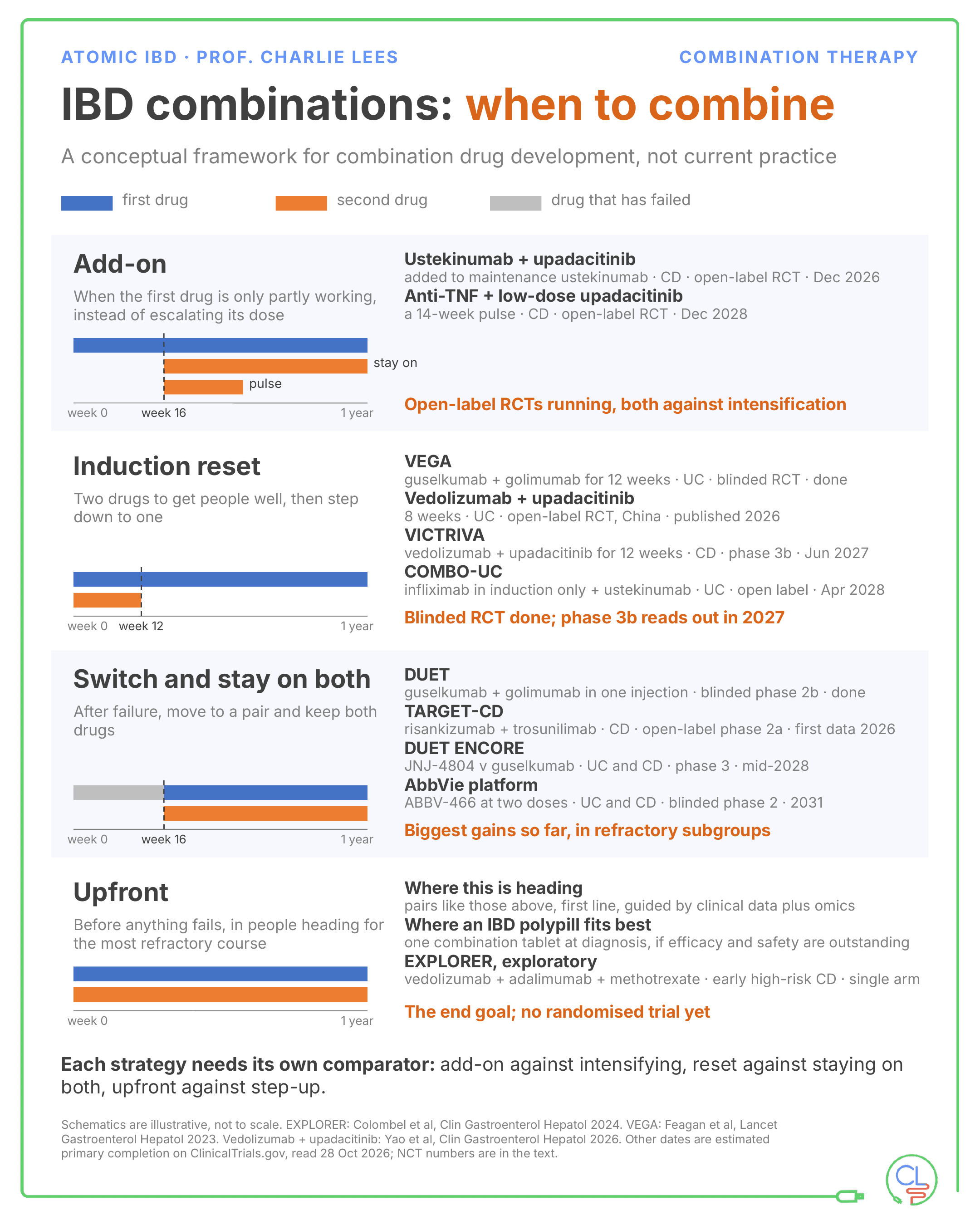
Add-on, when a drug is partly working. Instead of escalating the dose, you add a second drug, either to stay on or as a pulse. Two Chinese trials in CD are testing this against intensification: upadacitinib added to maintenance ustekinumab, and a 14-week pulse of low-dose upadacitinib added to an anti-TNF.
Induction reset: two drugs to get people well, then step down to one. VEGA did this, and its gap held after golimumab stopped. VICTRIVA (Takeda’s vedolizumab plus 12 weeks of upadacitinib in CD) and a Chinese trial in UC of vedolizumab plus 8 weeks of upadacitinib follow the same pattern, and TOPAZ-UC re-randomises responders to test whether both drugs are needed in maintenance. COMBO-UC does it too, stopping infliximab after induction and continuing ustekinumab. That worries me a little: anyone who later needs infliximab comes back to it after a drug holiday, with a real risk of antibodies.
Switch and stay on both, after failure. This is where DUET and TARGET-CD sit, and where the refractory subgroups gained most.
Upfront, before anything has failed. This is where it’s all heading. The pairs in DUET and TARGET-CD are being tested after failure, but they are ultimately designed to be used first line, in the people we can identify early as heading for the most refractory course. That needs prediction, from the clinical data we already have plus omics, and we and others are working on exactly that. It’s also where an IBD polypill would fit best: one combination tablet from diagnosis, if it can bring breakthrough efficacy with excellent safety. More on that in Part 2.
The trial evidence for going upfront is still thin. The only randomised data come from VEGA, in UC patients who had failed only conventional therapy, and it was small and exploratory. In CD, EXPLORER (vedolizumab, adalimumab and methotrexate in early high-risk disease) was single-arm, and ECCO’s 2024 guideline says there is no evidence yet for advanced combination therapy in people new to advanced therapy, even if high risk.
Each of these four strategies needs a different trial, a different comparator and, in the end, a different price. No company will test them all, because each tests its own drugs. That’s the case for a publicly funded platform trial: one master protocol testing biosimilar pairs alongside branded ones, and testing strategies as well as drugs. Add-on against intensification, reset against treat-through, upfront against step-up, with cost per remission built in so NICE and commissioners can use the answer.
What reads out when
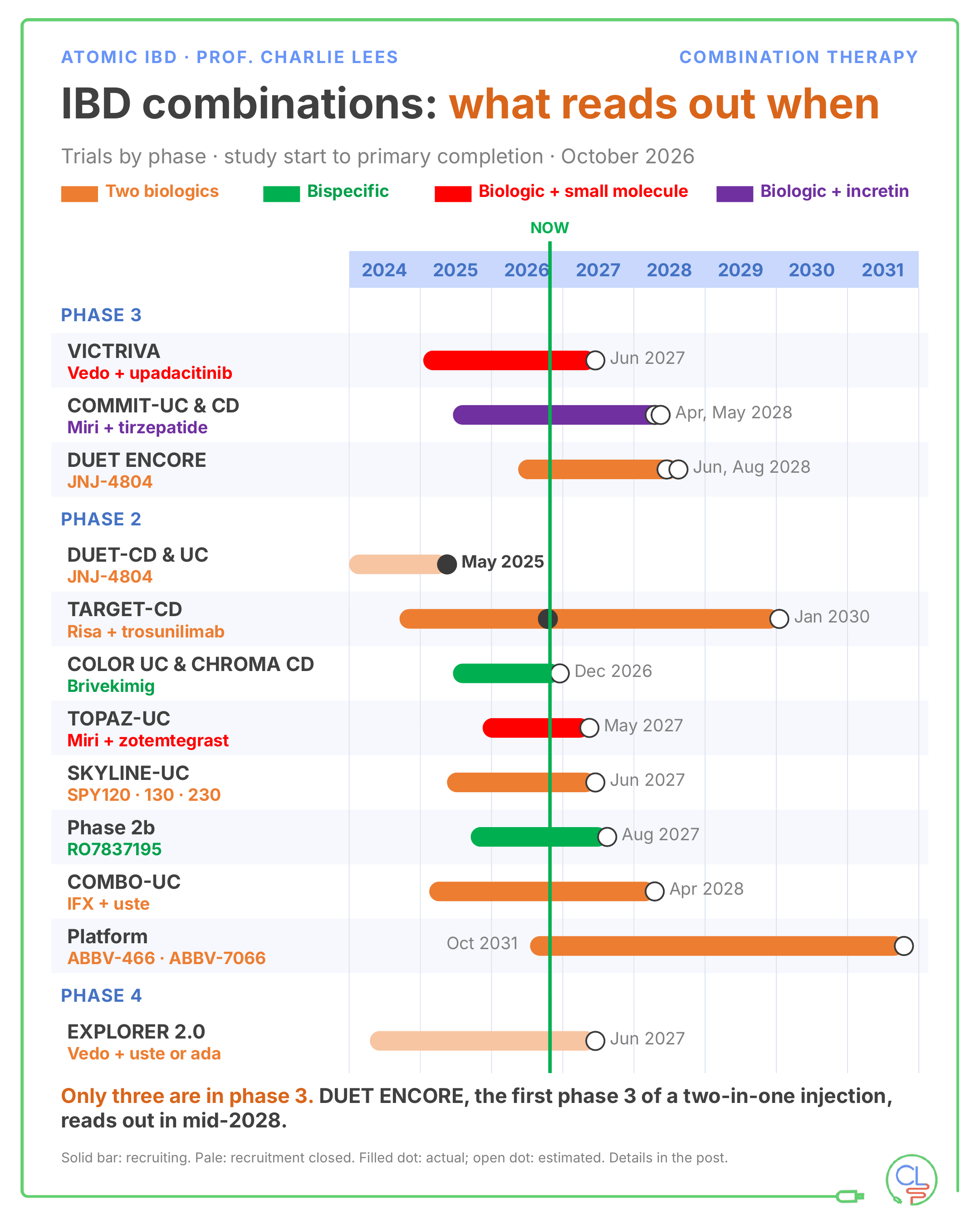
Two of these trials, plus COMMIT, are in phase 3. Takeda’s VICTRIVA comes first, in June 2027, testing vedolizumab with 12 weeks of upadacitinib in CD. Lilly’s COMMIT follows in spring 2028, and DUET ENCORE, the first phase 3 of a two-in-one injection, in mid-2028. Everything else is phase 2: brivekimig for UC in December, then TOPAZ-UC, Spyre’s pairs and Roche’s bispecific through 2027, COMBO-UC in 2028, and AbbVie’s platform out to 2031.
The COMMIT bar is a different kind of combination, and one I find fascinating (Figure 6). Lilly’s trials give mirikizumab with either tirzepatide (Mounjaro, sold as Zepbound for weight loss in the US) or placebo to people with UC or CD who also have obesity or overweight. That’s about 640 people in phase 3b, reading out in spring 2028. Mirikizumab is open label and tirzepatide is blinded against placebo. The primary endpoint combines the two conditions. In UC it is clinical remission plus at least 10% weight loss at week 52. In CD it is clinical and endoscopic remission plus at least 10% weight loss. Tirzepatide should win comfortably on weight. The question I care about sits in the secondary endpoints: does it do anything for the IBD itself? I’ll come back to GLP-1 drugs, obesity and IBD in a separate piece. It ties into diet, metabolism and inflammation, which I’ve wanted to write about for a while.
Box 2. Why GLP-1 drugs might matter in IBD
The evidence for anti-inflammatory effects of these drugs is building. In mice, GLP-1 receptors on lymphocytes in the gut lining seem to damp down inflammation directly, and in other organs some of the benefit looks independent of weight loss (Wong and Drucker, J Clin Invest 2025; Colwill et al, J Crohns Colitis 2025). In IBD the human data are still observational. A meta-analysis of 11 studies and more than 16,000 people on GLP-1 drugs found less surgery, with no sign that the drugs make IBD worse. But the benefit was seen in people with obesity, not in those without. Whether these drugs do anything for IBD beyond weight loss is exactly what COMMIT’s secondary endpoints may start to tell us.
Coming in Part 2
Part 2 turns to tablets, including whether an IBD polypill is realistic. Injection-plus-tablet combinations are already in trials, usually with two drugs to induce and one to maintain. Takeda’s VICTRIVA adds 12 weeks of upadacitinib to vedolizumab. Lilly’s TOPAZ-UC pairs mirikizumab with an oral α4β7. Odyssey plans a blinded trial of its oral OD-001 with vedolizumab, with topline results expected in the second half of 2027. The first randomised data are already out, from that Chinese vedolizumab plus upadacitinib trial, though it was open label and stopped early.
No oral-plus-oral trial is registered yet. But Abivax says it plans to pick a combination candidate for obefazimod by the end of this year, and Gilead has just bought an oral IL-23 receptor peptide to sit alongside its oral α4β7.
Separately, I’ll write a practical post on how I use combinations in clinic now, and who I’d consider them for.
Eight years ago no one would have funded the study I wanted to run. Now J&J, AbbVie, Spyre, Lilly and Takeda are all running versions of that idea, and most of the answers arrive in the next two years.
Introducing EdinburghIBD.com
Writing the next decade of IBD care
Advanced combination therapy gives us a way to break through the therapeutic ceiling in IBD, but getting it right in clinic depends on answering two harder questions: which patients are on an inflammatory trajectory that justifies early dual therapy, and how do we monitor them closely enough once they reach remission?
Today, we are launching EdinburghIBD.com—one home for our integrated research and clinical team at the University of Edinburgh and NHS Lothian, built around those exact questions:
The Data Foundations: Over 20 years of real-world follow-up in the Lothian IBD Registry (~10,000 patients, fully integrated with Dataloch) alongside the UK-wide PREdiCCt cohort (2,629 participants across 47 sites).
Four Research Programmes: Longitude (modelling inflammatory trajectories over time), Vantage (population-level clinical observability), Continuum (diet, microbiome, and whole-person health), and Cairn (built with patients).
SENTINEL (Our Flagship Platform): Clinician-supervised decision support and proactive monitoring designed to make the space between appointments safer and the next clinic conversation more useful.
Clinical Trials & Publications: Plain-language summaries of our 166 papers and details on 10 actively recruiting clinical trials: including new molecules, combination strategies, and intestinal ultrasound studies.
Whether you are a clinician, researcher, prospective fellow, or someone living with IBD, take a look around, and let me know what you think.
To make a donation towards our research programme click here.

Sources and links
Earlier combinations and scope - SONIC: Colombel JF et al, N Engl J Med 2010. PubMed 20393175 - UC SUCCESS: Panaccione R et al, Gastroenterology 2014;146:392. PubMed 24512909 - VEGA: Feagan BG et al, Lancet Gastroenterol Hepatol 2023. PubMed 36738762
DUET and DUET ENCORE - J&J release, 5 May 2026: jnj.com. Abreu MT et al and Sands BE et al, DDW 2026; Atreya R et al, UEG 2026. - DUET-UC NCT05242484; DUET-CD NCT05242471; DUET ENCORE-UC NCT07577856; DUET ENCORE-CD NCT07577843 - Placebo harms: Din S et al, Lancet Gastroenterol Hepatol 2024;9:1020-9 (induction), doi:10.1016/S2468-1253(24)00264-4; Gros B et al, Lancet Gastroenterol Hepatol 2024;9:1030-40 (maintenance), doi:10.1016/S2468-1253(24)00233-4
TARGET-CD and AbbVie - Panaccione R et al, UEG 2026, LB08. AbbVie release, 19 October 2026: news.abbvie.com - TARGET-CD NCT06548542; AbbVie platform study NCT07697456
Regulators and other fields - FDA, Codevelopment of Two or More New Investigational Drugs for Use in Combination (final guidance, June 2013) - EMA, Guideline on clinical development of fixed combination medicinal products (EMA/CHMP/158268/2017) - Opdualag: FDA approval, 18 March 2022; RELATIVITY-047 NCT03470922 - Phesgo: FDA approval, June 2020; FeDeriCa NCT03493854 - Etanercept plus anakinra: Genovese MC et al, Arthritis Rheum 2004;50:1412 (summary)
Pairs, bispecifics and biosimilars - SKYLINE-UC NCT07012395; brivekimig COLOR UC NCT06975722 and CHROMA CD NCT06958536; RO7837195 NCT06979336 - Ustekinumab biosimilar uptake: Medicines UK. Vedolizumab biosimilar: Goodwin, June 2026 - COMBO-UC NCT06453317; protocol: Talar-Wojnarowska R et al, Front Med 2024;11:1458998
When to combine - EXPLORER: Colombel JF et al, Clin Gastroenterol Hepatol 2024. PubMed 37743037 - ECCO guidelines on therapeutics in Crohn’s disease: Gordon H et al, J Crohns Colitis 2024 (PDF) - Add-on trials: NCT06520397 (ustekinumab plus upadacitinib), NCT07510191 (anti-TNF plus upadacitinib) - Induction reset: VICTRIVA NCT06227910; vedolizumab plus upadacitinib in UC, Yao et al, Clin Gastroenterol Hepatol 2026 (PubMed 42173298); TOPAZ-UC NCT07186101
COMMIT and GLP-1 drugs - COMMIT-UC NCT06937086; COMMIT-CD NCT06937099 - Bayoumy AB et al, J Crohns Colitis 2025;19(10):jjaf181 (meta-analysis), doi:10.1093/ecco-jcc/jjaf181 - Colwill M et al, J Crohns Colitis 2025;19(9):jjaf167 (review), open access - Wong CK and Drucker DJ, J Clin Invest 2025;135(21):e194751 (review), jci.org
Part 2 - Odyssey OD-001 plus vedolizumab: release, 12 October 2026 - Abivax 2026 outlook, 7 January 2026: ir.abivax.com - Gilead to acquire HCXT-2001, 22 October 2026: gilead.com
Really amazing summary. Thank you for what you do.