


Edinburgh IBD Research Group | Year in Review 2025 & Vision for 2026
“We are, genuinely, in the disease-modifying era of IBD. The task now is to combine science, strategy and trust so that most people, most of the time, can live the long, full lives they deserve.”
Why This Matters Now
IBD care is entering a new era. Complexity has overtaken capacity.
In 2025, the field shifted. Therapy sequencing became the story. The hierarchy changed under the weight of comparative evidence. The question stopped being “what works?” and became “what works first, for whom, for how long, and can we deliver it in real clinics?”
Science is moving fast. Clinics are not.
That gap between what science makes possible and what health systems can reliably deliver is exactly where our work sits.
Our group’s mission is simple to say and hard to do: predict, personalise, and prevent inflammatory bowel disease. We are building data-driven tools that learn from the signals already present in routine care, combine them with prospective multimodal cohorts, and translate that into practical, compassionate, world-leading care.
This is a review of what we built in 2025, who built it, what we learned, and the 2026 plan. The year we turn platform into practice at scale.
What We Are Building
We are building a transformative IBD medicine programme designed to improve lives wherever people live. Through research. Through compassionate care. Through scalable digital translation.

At its centre is SENTINEL.
SENTINEL is an AI-driven, clinician-supervised decision support tool designed to shift IBD care from reactive and crisis-driven to proactive and personalised. It runs alongside the EHR. It turns routine inflammation signals into daily, pathway-aligned action prompts for clinical teams. It learns each patient’s unique inflammatory pattern from routine CRP and faecal calprotectin results, predicting deterioration weeks before symptoms develop.
It has one rule: usefulness first.
The system generates daily risk-prioritised lists and trajectory-aware prompts for nurse-led triage and treatment optimisation. Critically, it works from labs alone. Benefits accrue from day one even if patients never engage with additional features. Equitable and operationally robust.
Around SENTINEL sits an ecosystem:
The Lothian IBD Registry: approximately 10,000 patients, 20+ years of longitudinal data, 20 years of faecal calprotectin results all measured on the same laboratory assay. A data asset that cannot be easily replicated. Now fully integrated with DataLoch.
Danish national registry data through our collaboration with PREDICT at Aalborg University, validating methods across 70,000+ patients.
PREdiCCt, our UK-wide prospective cohort of 2,629 participants across 49 NHS sites, capturing deep baseline phenotyping with longitudinal follow-up. Built for prediction, prevention, and real biological insight into why flares happen.
A broad collaborative network: nationally, and globally - across epidemiology (GIVES-21), genetics (UK IBD Bioresource and International IBD Genetics), microbiome and diet (IBD-response, PREdiCCt), metabolomics (Nightingale Health), multi-omics (IBD-OPEN), translational clinical research (PANTS, PRED4, CLARITY, VIP, PROFILE), and policy (the Lancet Commission on Global IBD).
And Atomic IBD. My effort to translate the fast-moving science of IBD into signal, clarity, and hope for clinicians, patients, and partners worldwide.
The Foundations
I started gastroenterology training in 2003. I’ve been a consultant in NHS Lothian since 2009.
I am a clinician first.
The clinic is where this entire programme comes from. Not as an abstract “digital health” idea, but as a response to real pain points: inflammation rising quietly in the background, patients becoming unwell before we can get to them, helplines overwhelmed, capacity stretched, decisions increasingly complex.
When I began in Edinburgh, too much of IBD care meant cycling steroids to control flares and accepting too many surgeries while chronic inflammation quietly accrued harm over decades. Today, we can set people up for success from day one. Prompt diagnosis. Full assessment. Effective therapy early rather than asking patients to “earn” their way to it.
Edinburgh is unusually well placed for what comes next. World-class biomedical data science at the Institute of Genetics and Cancer, paired with one of the most complete longitudinal IBD real-world cohorts globally.
2025: Platform Year
This was a year defined by turning what we’d built over decades into something deployable.
Infrastructure
The Lothian IBD Registry is not just a dataset. It’s a living clinical history of IBD in an entire region.
In 2025, the integration with DataLoch matured into something that can support real translation: the pathway from routine data to analytics to action in clinical workflows. This matters because modern IBD care has outgrown the old model of waiting for symptoms to declare themselves.
If we can learn from routine longitudinal biomarkers, we can create earlier, calmer interventions. Fewer crises. Fewer steroids. Fewer emergency admissions. More trust in care.
Methods
We’ve been building an approach to IBD that treats inflammation as a trajectory, not a snapshot.
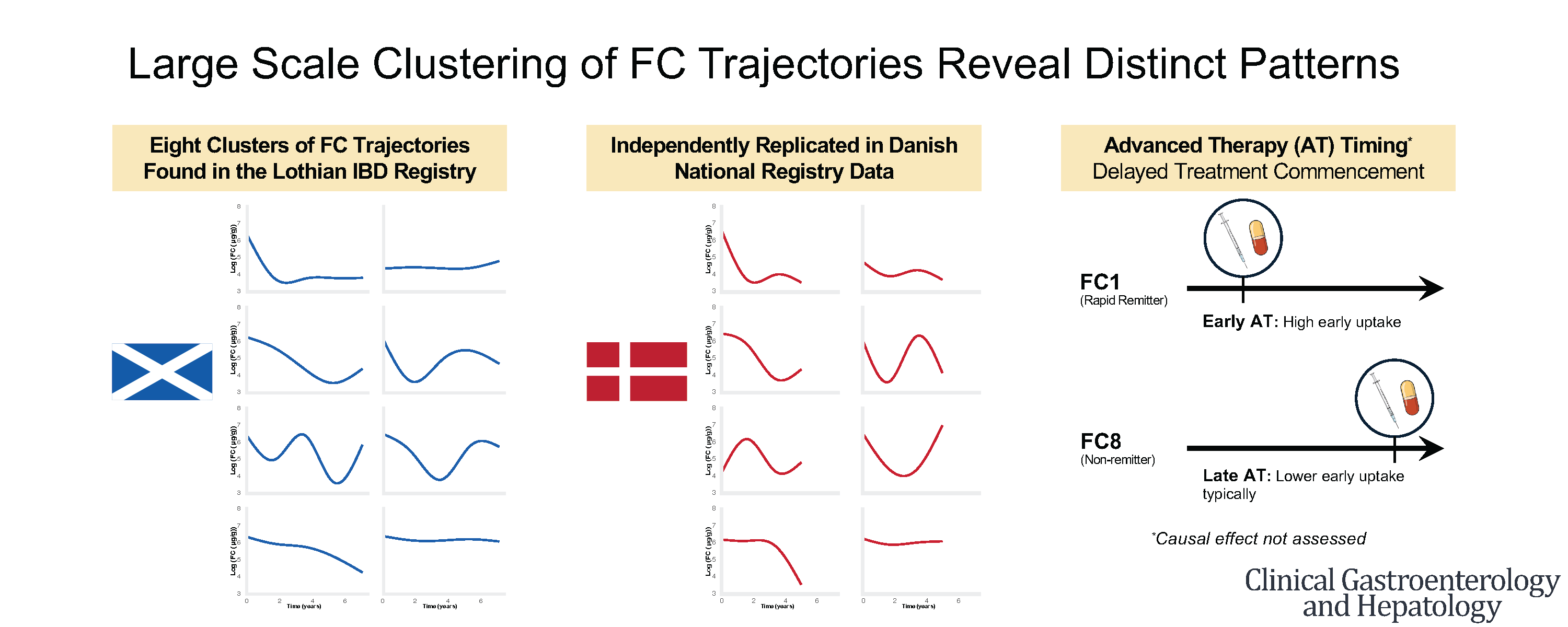
In 2025, that trajectory view matured into a platform capability. Nathan Constantine-Cooke led the work mapping inflammatory trajectories using faecal calprotectin and CRP. Using latent class mixed models, we identified eight distinct FC and eight CRP trajectory patterns: rapid remitters, delayed remitters, relapsing-remitting disease, and non-remitters. These were independently replicated in Danish national registry data with Professor Tine Jess at PREDICT.
The paper was published last week in Clin Gastro Hep.
Victor Velasco-Pardo built landmaRk, an R software package that combines landmarking with latent class mixed models. Tested, validated, and ready for operationalisation. Stats paper online soon.
This is what powers SENTINEL. A system that learns each patient’s pattern and uses new lab results as updates, not noise.
Translation
SENTINEL moved from prototype thinking to genuine deployment readiness. A clinician portal. Lab ingestion. Workflows. A design philosophy that puts equity first.
The MVP is functional. CRP and faecal calprotectin ingestion operational. Phenotypic inputs from the registry integrated. Live wearable feed incorporated in the demo environment.
This is not AI for AI’s sake. It is service redesign powered by predictive analytics.
PREdiCCt
PREdiCCt shifted into output mode. The first paper, accepted by Gut, shows baseline faecal calprotectin predicts objective flares even when patients feel well. A UC-specific association between higher meat intake and roughly double objective-flare risk.
The second paper, presented at ECCO 2025, found that depression and lack of exercise predict objective flares in ulcerative colitis. Signals that these factors belong in relapse-risk assessment alongside biomarkers.
A major metagenomics paper is forthcoming.
Publications
Our work continues to drive real changes in clinical practice worldwide.
The Nature paper from Hracs et al. and the GIVES-21 consortium documented IBD’s global evolution across epidemiologic stages. Ebert et al. in the American Journal of Gastroenterology delivered the first phenome-wide association study across more than 1,500 comorbidities. Gros et al. on ftofacitinib versus vedolizumab in UC (JCC). Twenty-year trends in ulcerative colitis: colectomy rates and advanced therapy prescribing in Lothian published in AP&T.
Trials
Edinburgh remains a major centre for IBD clinical trials, both commercial and investigator-led.
Commercial studies currently recruiting include TARGET (AbbVie phase 2 platform combination study in CD), VICTREVA (Takeda vedolizumab plus upadacitinib combination in CD), VECTORS (vedolizumab treat-to-target with intestinal ultrasound in early CD), and ICONIC (Janssen phase 3 oral IL-23 icotrokinra in UC).
Non-commercial studies include OPEN-IBD, IBD-RESPONSE, ACCESSO, OCEAN, GONDOMAR, and the IBD Bioresource.
The future of IBD care will not be built in one type of study. It will be built at the intersection of real-world outcomes, rigorous trials, mechanistic insight, and care pathways that can scale.

Atomic IBD exists because science only helps patients when it becomes practice.
The platform continued to grow: 4,174+ newsletter subscribers, 21,200+ followers on X, 2,950+ YouTube subscribers. The year-end review series captured the field’s inflection point (Part 1 - Part 2 - Part 3). Two premium video productions filmed at Elstree Studios (very excited to release these soon). 30 to 40 Atomic IBD Uncut episodes. Regular atomic essays.

For our group, Atomic IBD is not separate from research. It is part of the translation pipeline.
The People
No serious programme is the work of one person.
Multidisciplinary. Co-located. Aligned.
The Research Group
Our post-doctoral data scientists sit at the heart of what makes our approach distinctive. Nathan Constantine-Cooke leads SENTINEL technically and pioneered our inflammatory trajectory modelling. Victor Velasco-Pardo created the landmaRk software and leads our cumulative inflammatory burden work. Alex Rudge drives forward our analytical capabilities. This team sits jointly across our group and Dr Catalina Vallejos’ biomedical data science group.

Our clinical fellows bridge the gap between data science and patient care. Clara Ramos-Belinchon works with Victor on cumulative inflammatory burden scoring. Elliot Gemmell advances our clinical data science capabilities. Alex Elford and Beatriz Gros have been prolific in producing real-world evidence. Nik Plevris, now consultant locally, provides the clinical-academic bridge that defines our approach.
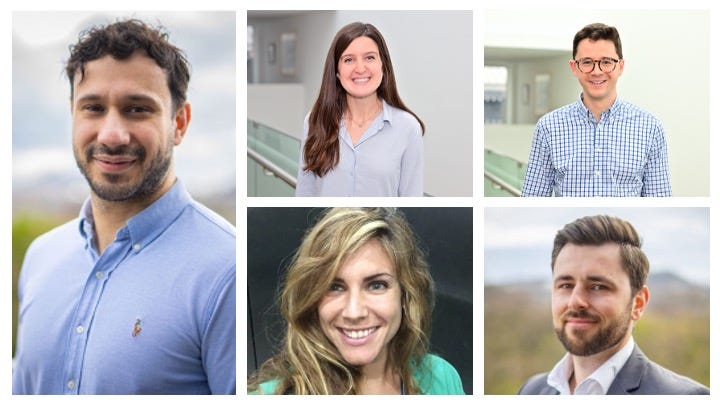
Our research operations team makes large platforms real. Debbie Alexander leads, with Claire McQuillian and Louise Taylor. Asim Azfer runs our laboratory science.
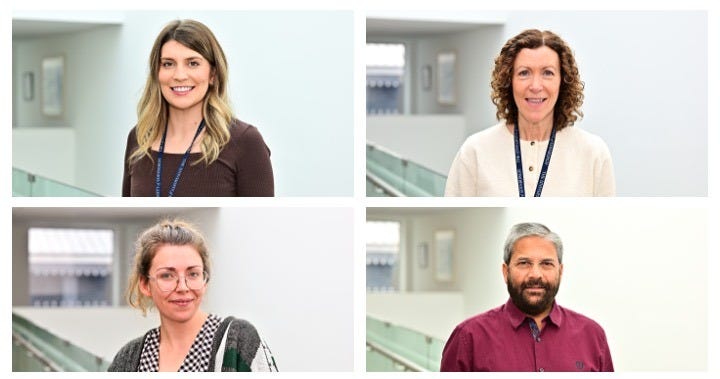
Edinburgh IBD Clinical-Academic Community
Research in Edinburgh extends well beyond any single group.
Jonny Blackwell is local PI for OPEN-IBD. Shahida Din leads Accesso locally with her fellow Amir and runs a programme on colitis-associated cancer and Crohn’s fibrosis with local collaborators. Rahul Kalla leads FATE-CD at the Royal Infirmary, using PET imaging to study fibrosis in Crohn’s disease with his fellow Lex. Eleanor Watson (at WGH) and Richard Russell (at the Sick Kids Hospital) lead clinical implementation for SENTINEL. Ian Arnott, clinical director for gastroenterology, has supported IBD research in Edinburgh for over two decades.
This breadth of clinical-academic activity, all under one regional service, is rare. It makes Edinburgh a powerful environment for IBD research.
The Wider Clinical Team
None of this happens without the clinical infrastructure that supports it.
Our IBD specialist nurses and pharmacists are the backbone of patient care and trial delivery. Our administrators keep the machinery running. Our surgeons, radiologists, and pathologists contribute expertise that shapes every aspect of our work.
Challenges
A serious review has to name the friction.
Building in the NHS means building through complexity. Data governance, workflows, and service realities are not side issues. They are the core. Translation is mostly not about brilliant ideas. It’s about relentless operational execution.
Prediction is only useful when it changes action. The hardest step is not modelling. It’s the last mile: presenting risk in a way that clinicians trust, that nurses can use daily, and that improves outcomes without increasing burden.
Capacity is the hidden limiting reagent. That’s why “better drugs” is only part of the story. The real innovation is systems that help us deliver what we already know works.
2026: Delivery Year
This next year is about consolidation and delivery.
SENTINEL Goes Live
January 2026 marks the launch. Our objective: flip approximately 30% of nurse-helpline workload from reactive calls to proactive outreach based on predicted risk.
What success looks like:
A shift from reactive helpline firefighting to proactive outreach
A daily, risk-prioritised view of the caseload
Trajectory-aware prompts aligned to pathways
A learning system that improves through supervised use
This is the year we turn predictive models into an embedded clinical service.
Scale Readiness
Several major NHS boards beyond Lothian are committed as early adopter sites. We are building reproducible pipelines to ensure outputs are rapidly usable by others. Doing the hard work of evaluation, safety, and regulatory readiness.
Intentional Leadership
My personal focus: leadership, vision, and funding. More intentional travel and speaking. Fewer low and mid-tier engagements. Building SENTINEL and Atomic IBD as platforms that can scale impact far beyond what any individual can achieve in clinic.
The Lancet Commission on Global IBD reports at ECCO in February. A milestone in articulating the global challenge and the solutions we are building.
Work With Us
Come build with us.
We want collaborators who have cohorts or registries that can validate generalisability. Who want to co-design pathway-aligned decision support. Who can help us test the ethics, safety, and fairness of predictive systems in the real world.
We want partners who care about scalable multi-omics, remote monitoring, and pragmatic evaluation. Who want patient-centred innovation that works even when engagement is variable.
We want patients excited about the direction of travel. SENTINEL is designed to ensure that care finds you before crises occur.
Join Us
We are hiring.
Advanced Clinical Fellow, Edinburgh IBD Unit. World-leading centre, cutting-edge research, advanced training in IBD and data science. Application deadline: 5 January 2026. How to apply
AI4BI CDT PhD Studentship (Project 24). Fully funded 4-year programme for September 2026 entry: SENTINEL, multi-modal dynamic prediction for proactive, personalised IBD care. Application deadline: 20 January 2026. Project details | How to apply
Looking Forward
2025 was the year we built the platform. 2026 is the year we prove what it does.
A world-class NHS service. Long-run real-world data. Serious statistical modelling. Prospective multimodal cohorts. A high-energy team. Pointing in the same direction.
IBD is heterogeneous, dynamic, and unpredictable. For many it spans six or seven decades.
The task of modern IBD care is to hold optimism for the newly diagnosed while maintaining empathy for those living with IBD for 40, 50, 60+ years. SENTINEL represents our commitment to that task. Using the data we already collect, the methods we have developed, and the tools we are building.
This is the disease-modifying era of IBD. The task now is to combine science, strategy, and trust. And that is exactly what we are doing.
Connect
Professor Charlie W. Lees University of Edinburgh | NHS Lothian | UKRI Future Leaders Fellow
X: @charlie_lees Newsletter: charlielees.substack.com YouTube: @charlie_lees Research Group: Lees Group at IGC
Edinburgh IBD Research Group | Institute of Genetics and Cancer | University of Edinburgh January 2026