


This week started with a question I was asked in Brazil. What’s been the most important development in IBD over the last decade?
My answer... biosimilars.
They let us use anti-TNF drugs when we wanted, at the doses we wanted, for everyone who needed them. In Edinburgh that meant top-down therapy for Crohn’s ten years before PROFILE. Less surgery. Fewer admissions. Better outcomes.
Now it’s happening again, further along the timeline. Biosimilar ustekinumab is here, at anti-TNF prices. Biosimilar vedolizumab looks likely by the end of 2027.
Within a decade, everything we use today will be biosimilar or generic.
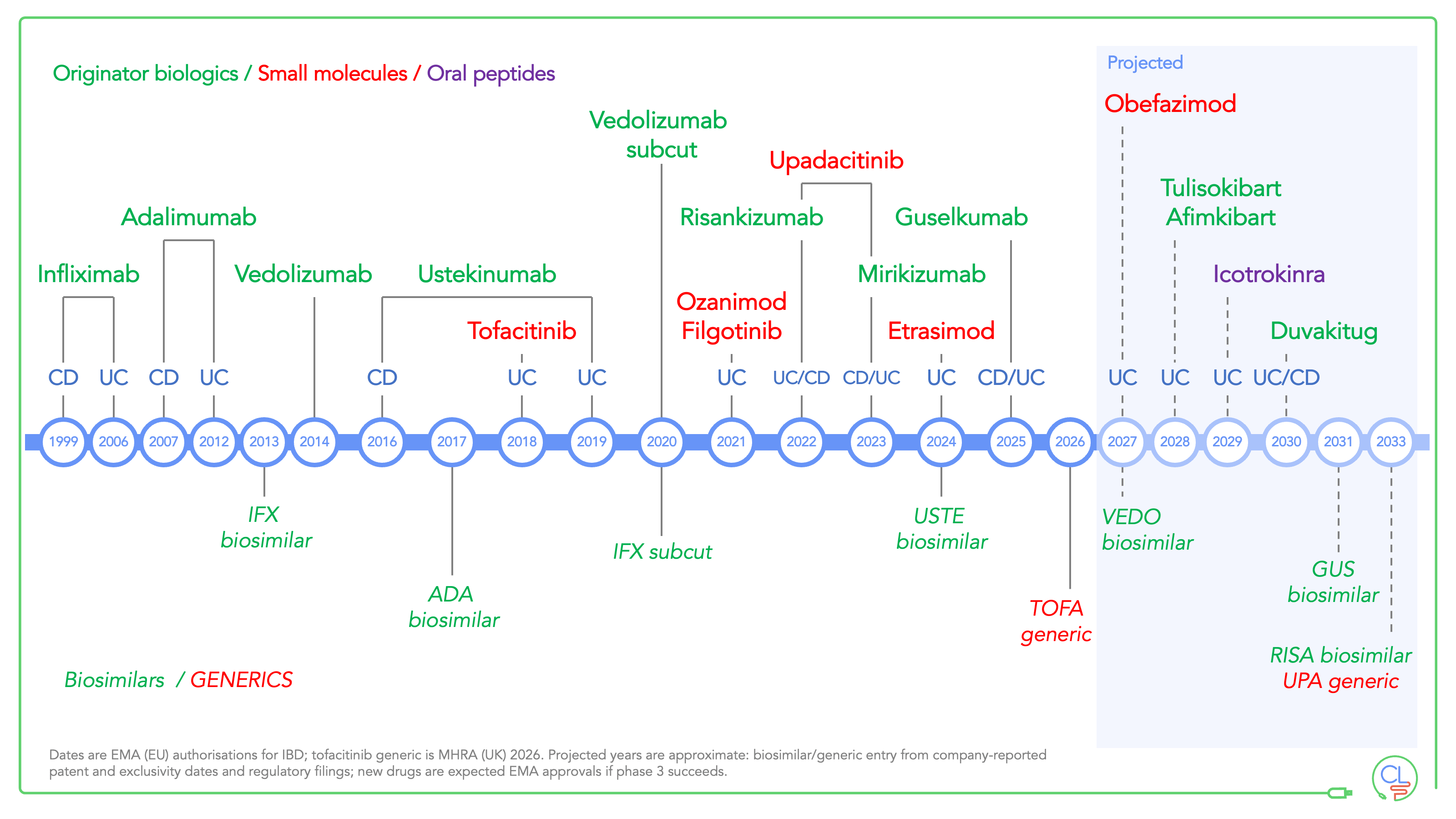
The gaps are shrinking. Infliximab went biosimilar in 2013. Adalimumab in 2017. Ustekinumab in 2024. Generic tofacitinib was approved in the UK this year. Guselkumab follows around 2031, risankizumab and upadacitinib around 2033.
That frees up money, and headroom. So what fills it?
What’s coming
20 new molecules in phase 2 or later. Eight targets, plus dual-target combinations.
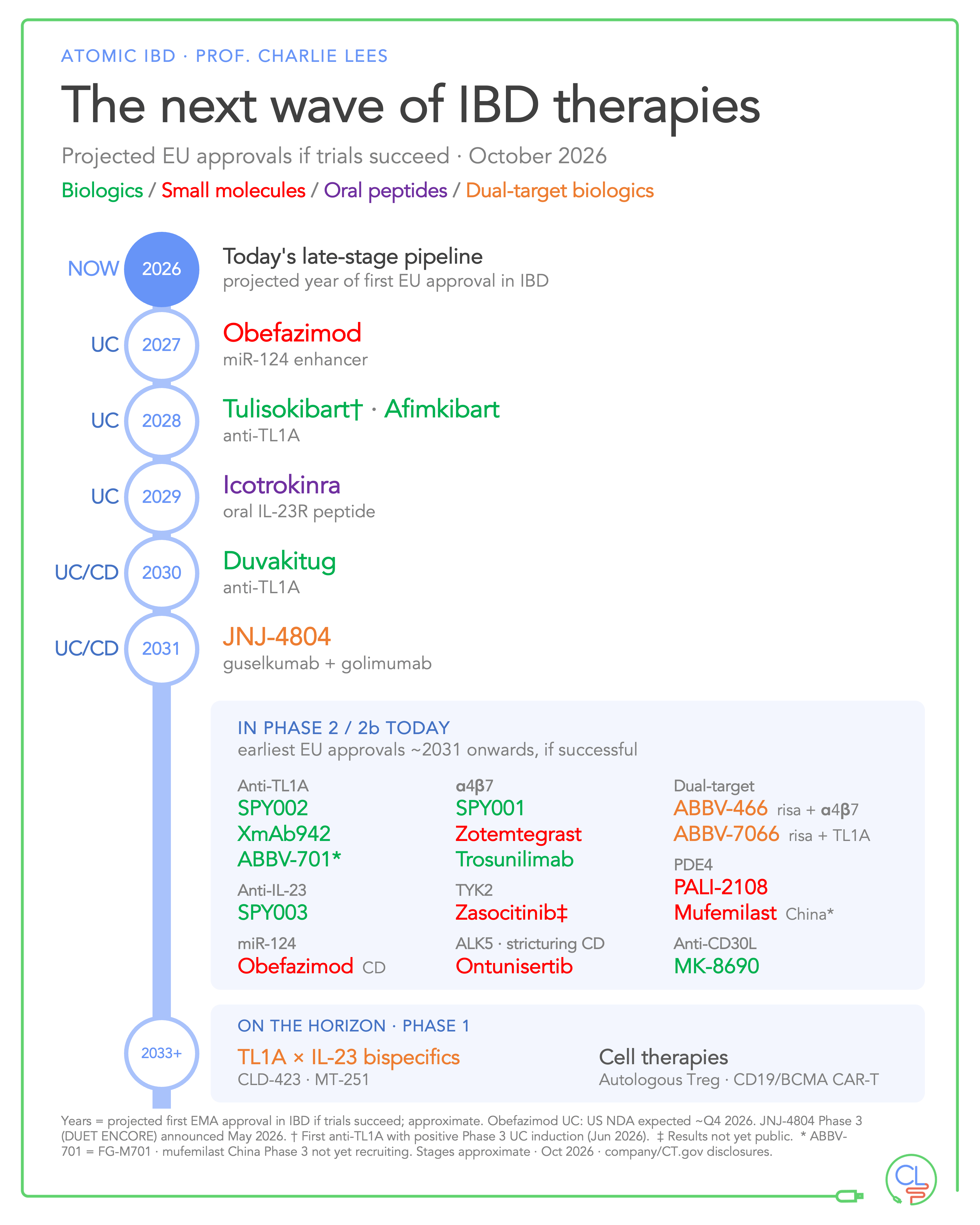
Read it from the top down. Each circle is the year a drug could first be approved in Europe if its trials succeed: obefazimod in 2027, the first anti-TL1As in 2028, and on to 2031. Below that sits phase 2, grouped by mechanism, then phase 1. Colour tells you the kind of drug: green for biologics, red for small molecules, purple for oral peptides, orange for dual-target.
Three anti-TL1As in phase 3.
An oral IL-23 receptor peptide.
A first-in-class miR-124 enhancer heading for filing.
Long-acting antibodies that might be given every three to six months.
And an anti-fibrotic for stricturing Crohn’s... something we have never had.
If their trials succeed, up to six could be approved in Europe by 2031.
When it reads out
I mapped every phase 3 trial in UC and Crohn’s against ClinicalTrials.gov. Start date to primary completion, with the company and NCT number for each.
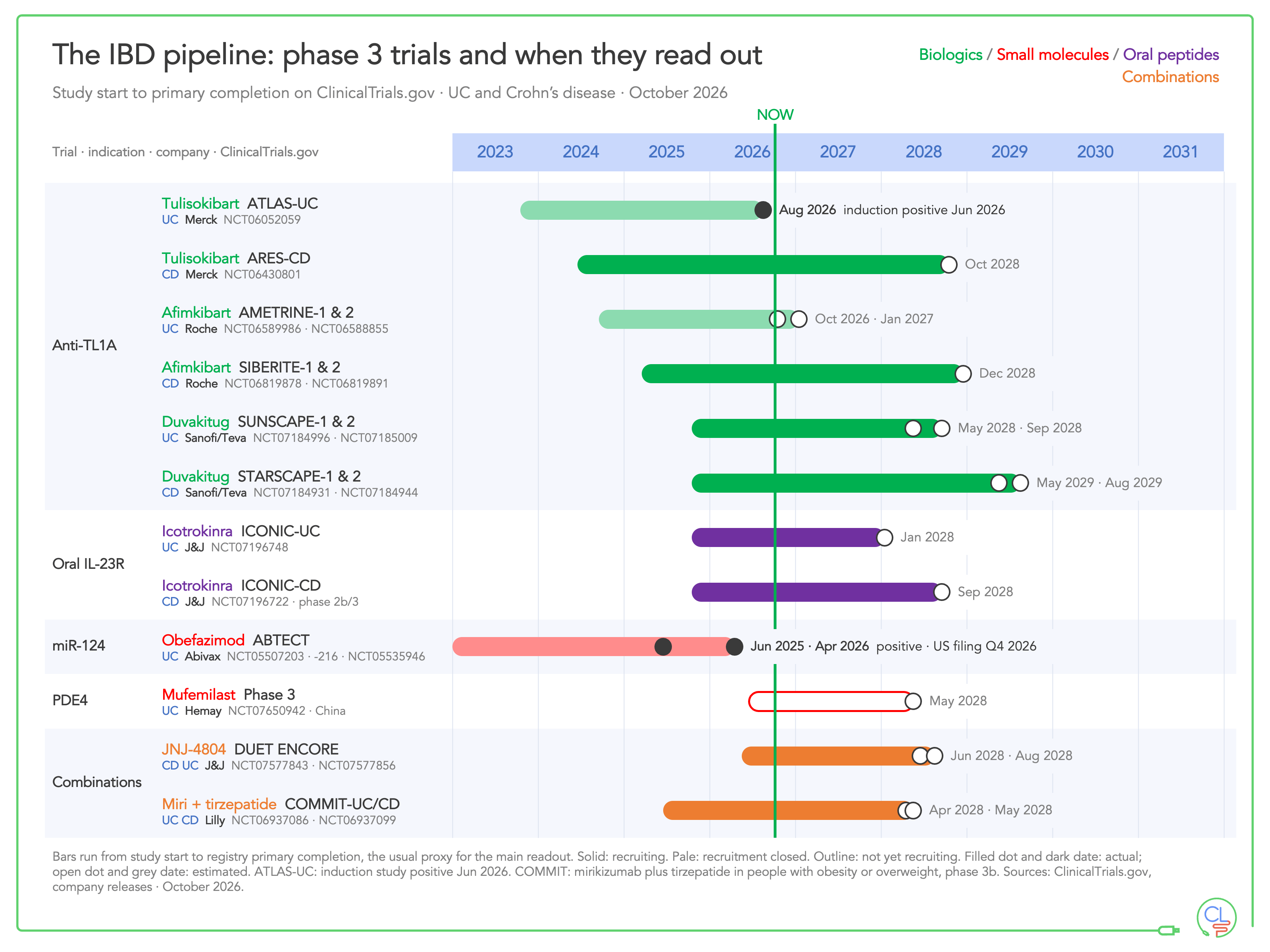
Each bar is one trial, from the day it started to its primary completion date, the usual proxy for when the main result lands. Solid bars are still recruiting; pale bars have finished. A filled dot means that date has passed; an open dot is still an estimate. The green line is today.
One year jumps out... 2028.
12 of the 16 phase 3 studies still to complete are due in 2028. And 11 of those 12 are recruiting right now. Look down the right-hand side and the open dots pile up.
Behind it... phase 2
That’s the front of the queue. Behind it sit about 60 programmes in phase 2, across 17 mechanism groups. And that undercounts China.
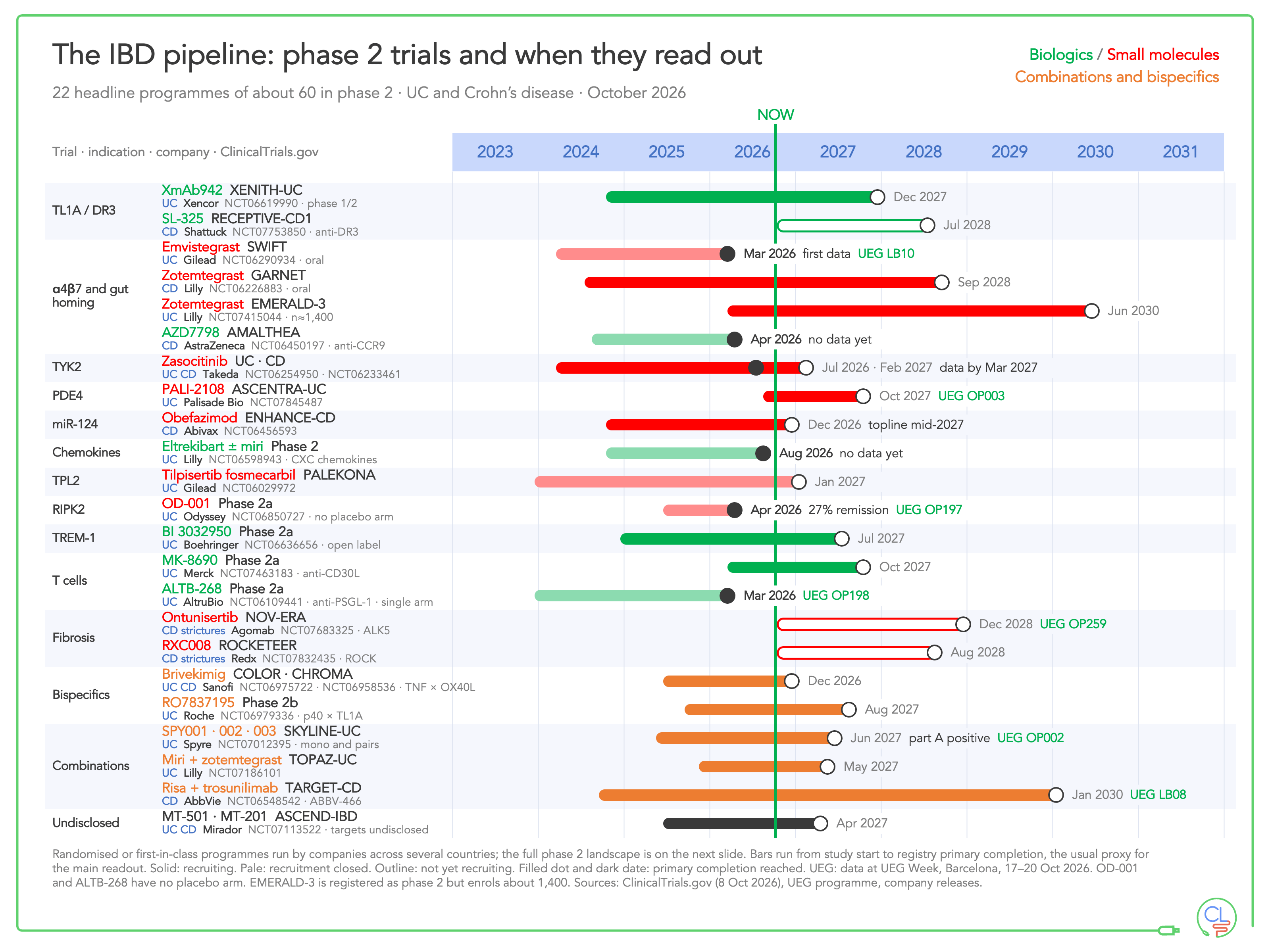
I’ve picked 22 to watch. Same layout as the phase 3 chart, grouped by mechanism of action this time. The green tags are the seven with data at UEG next week.
Three have passed primary completion with nothing out yet: zasocitinib in UC, eltrekibart (Lilly) and AZD7798 (AstraZeneca).
12 of the 22 are due to complete by the end of 2027. TYK2 and obefazimod in Crohn’s. Two bispecifics. Spyre’s long-acting antibodies, alone and in pairs. Mirikizumab plus an oral α4β7.
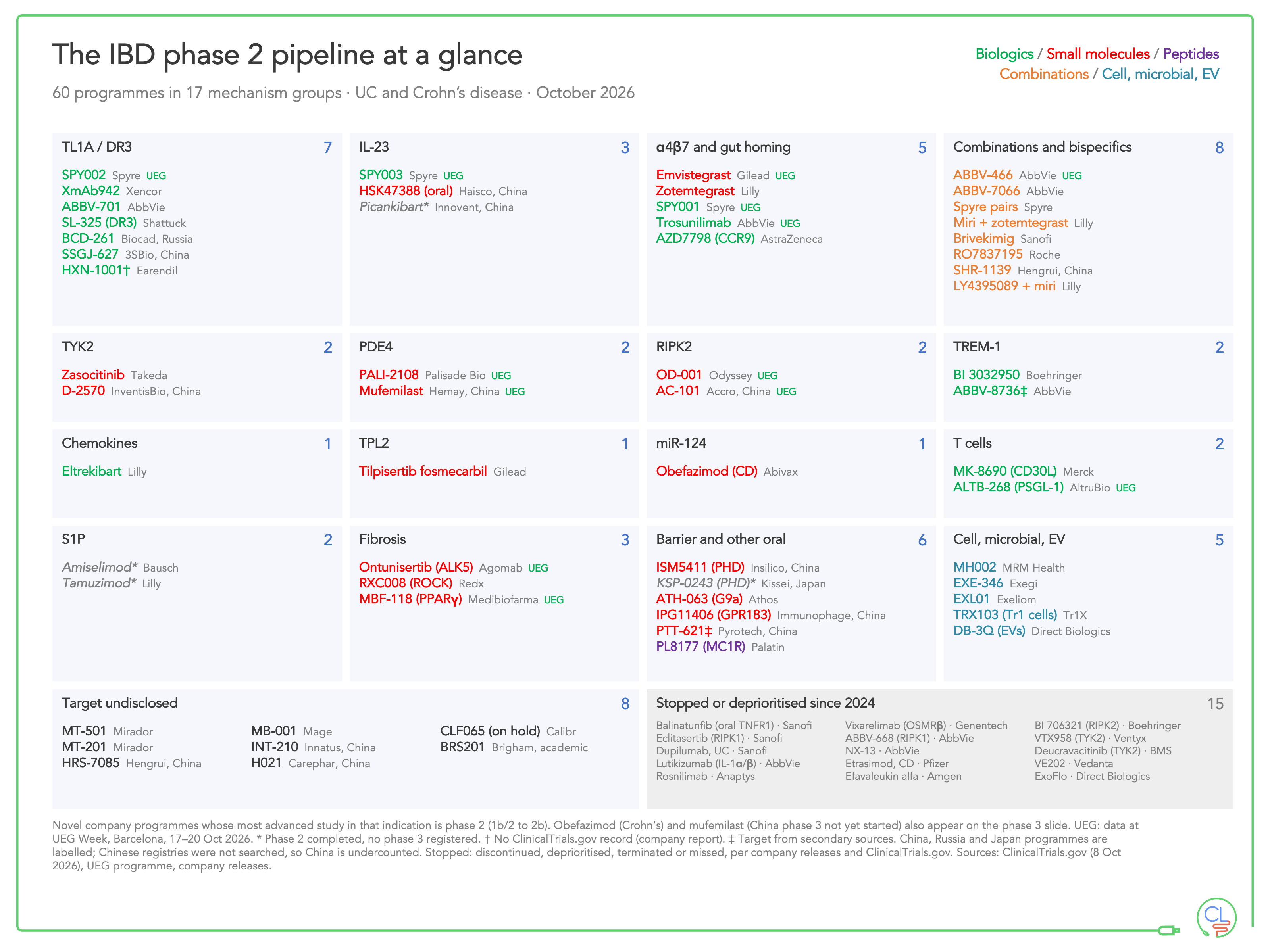
This is the whole field. One tile per mechanism of action, with the company for each programme. Grey italics have finished phase 2 with no phase 3 registered. And the box at the bottom is the other half of the story.
Not everything makes it. At least 15 programmes have been stopped or deprioritised since 2024, oral TNFR1 (balinatunfib) among them in July.
That’s what phase 2 is for.
Next week in Barcelona
Seven of the 22 present at UEG Week, 17–20 October. I’ll be there.
Sunday: Spyre’s three long-acting antibodies in UC. And a gut-activated PDE4 (PALI-2108) in stricturing Crohn’s.
Monday: first data for Gilead’s oral α4β7 (emvistegrast)... and risankizumab plus an anti-α4β7 in Crohn’s (ABBV-466). Both late-breakers.
Tuesday: RIPK2 (OD-001), PSGL-1 (ALTB-268) and the anti-fibrotic ontunisertib in stricturing Crohn’s.
I’ll post the results as they land. Most are under embargo until then.
What has already read out
Obefazimod (Abivax). Positive phase 3 induction in July 2025. Then in June this year, 51% of induction responders on 50 mg were in clinical remission at week 44, against 10% on placebo. US filing planned for Q4.
Tulisokibart (Merck). ATLAS-UC induction met its primary and key secondary endpoints in June. The numbers are still to come.
Spyre’s long-acting antibodies. In the open-label part A of SKYLINE, all three reduced inflammation on biopsy at week 12, the study’s primary endpoint (the Robarts Histopathology Index). Clinical remission was 40% for SPY001 (α4β7), 33% for SPY002 (TL1A) and 20% for SPY003 (IL-23). No placebo arm, so these are signals rather than comparisons, for now. The randomised part B, with the pairs, reads out in 2027.
OD-001 (Odyssey). An oral RIPK2 inhibitor. 27% clinical remission at week 12 in 49 patients. Single arm, no placebo. Full data at UEG.
Zasocitinib (Takeda). The UC phase 2 finished in July. Takeda lists both the UC and Crohn’s readouts in this financial year, which ends in March 2027.
What it needs from us
None of those 2028 dates is guaranteed. Primary completion depends on recruitment. Recruitment depends on sites... how quickly studies open, whether every eligible patient is offered a trial, and whether research teams have the time to run them properly alongside full clinical jobs.
That’s the part we can fix. Faster set-up, and every eligible patient offered a trial. That’s how 2033 becomes 2031.
The challenge has shifted to IMPLEMENTATION. Of the drugs we have, and of the trials that will bring us the next ones.
The science is ready. Now it’s on us.
Next week: head-to-heads, strategy trials and combinations. We have the drugs. How do we choose them, and how do we use them?
Trial dates are registry estimates from ClinicalTrials.gov (6–8 October 2026) and they move. Company results are linked where they appear.
Charlie, at what point do you offer clinical trials to patients? With so many options its tempting to cycle through the classes when one is not efficacious but at what point do you steer towards a trial?
Grazie per queste tante buone notizie.