


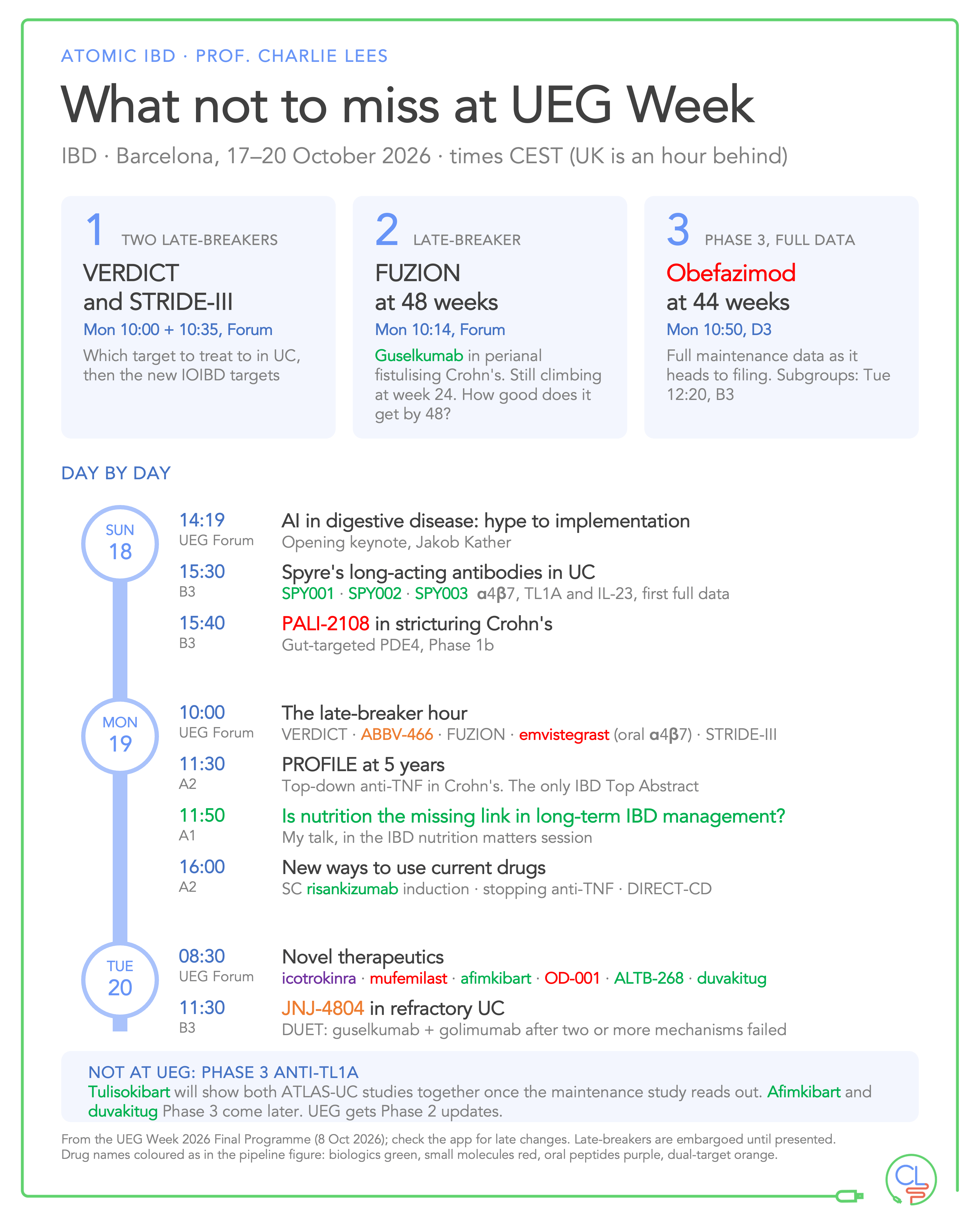
UEG Week opens in Barcelona on Saturday 17 October. The programme has more than a thousand IBD items. These are the ones I’ll be watching, with times in Barcelona time so you can find them.
First, some news from home. My team’s new website is live: edinburghibd.com. Edinburgh IBD is a fully integrated research team, writing the next decade of IBD care by bringing together long-term patient data, clinical expertise and lived experience. Go take a look!
The hour not to miss
Monday 10:00, in the UEG Forum. Six late-breakers in 42 minutes, and two of them ask the same question.
VERDICT is hugely important. It’s the first strategy trial to test whether histological healing matters in UC. 672 patients with active UC, all treated with vedolizumab, were randomised to one of three targets: symptoms alone, symptoms plus endoscopic remission, or all of that plus histological remission. Vedolizumab was escalated as needed to reach each patient’s target, checked at weeks 16, 32 and 48. Patients who reached their target were then followed to week 96 for UC complications: admission for a flare, colectomy, or rescue therapy such as steroids.
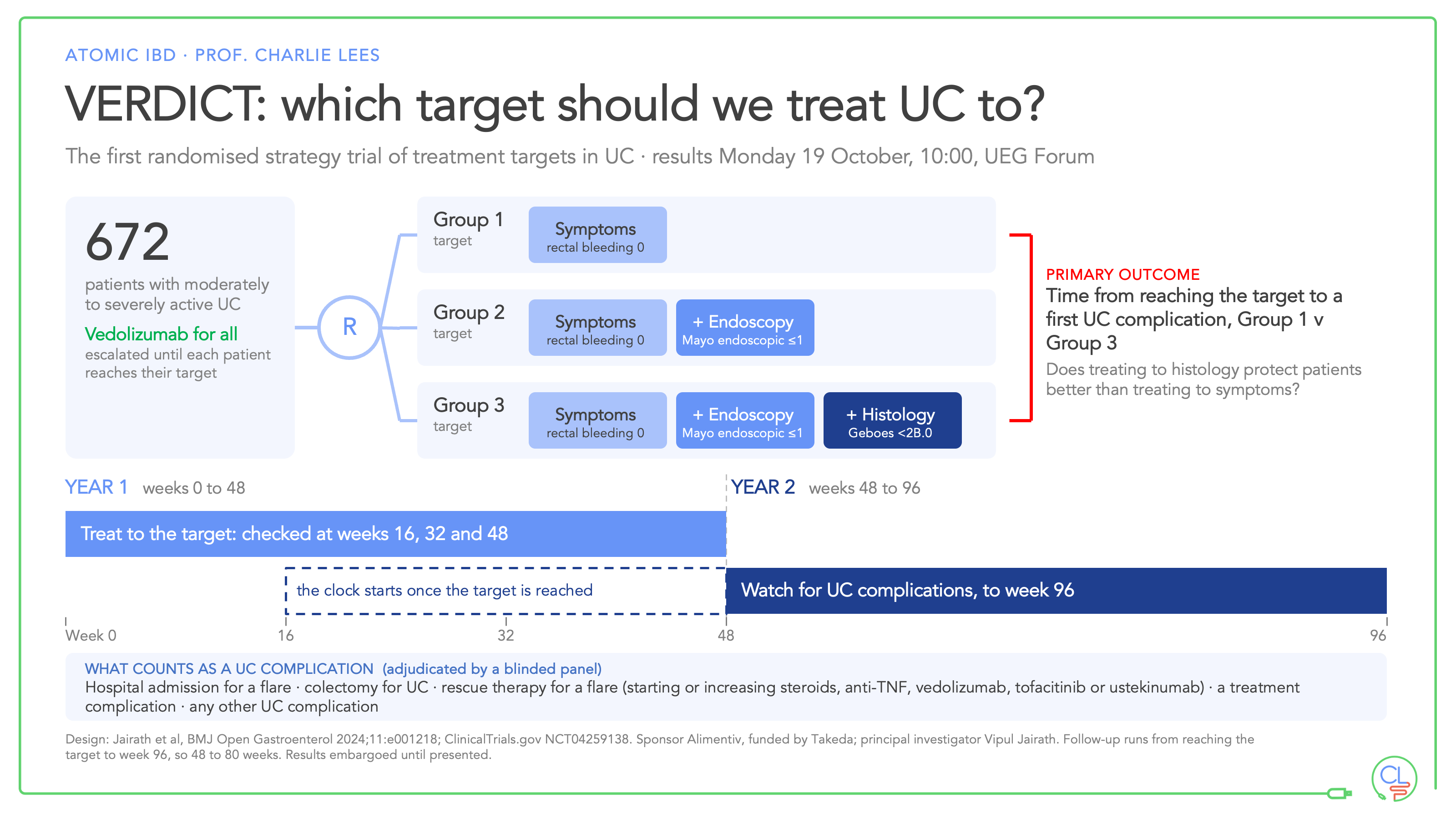
For me the question that matters isn’t histology against symptoms. Most of us already treat to endoscopic healing. It’s whether chasing histology on top of that buys anything: fewer admissions, fewer colectomies, fewer courses of steroids. That’s histology against endoscopy, group 3 against group 2. The trial’s registered primary comparison is histology against symptoms, and the next step in its testing order is endoscopy against symptoms. Histology against endoscopy is the result I’ll be looking for on Monday.
If histology wins, the bar goes up for everyone: more biopsies, or stricter calprotectin targets, and more escalation in people whose mucosa already looks healed. If it doesn’t, we can stop chasing it.
My worry is the numbers. The trial was designed around complications in 23% of patients treated to symptoms and 7% of those treated to histology, with about 100 patients reaching each target. That’s only around 30 events in all. By my calculation, if the real gap is smaller, say 20% against 10%, the chance of a clear result falls to about a coin toss. And the gap between endoscopy and histology will almost certainly be smaller than the gap between symptoms and histology. So a neutral VERDICT on the question that matters wouldn’t prove that histology doesn’t matter.
Strategy trials like this are slow and hard to run. Vipul Jairath has led VERDICT since the protocol was written eight years ago, through a start-up in the pandemic, across 60 sites in 10 countries. He tells the story here. A huge piece of work.
At 10:35 comes STRIDE-III. STRIDE-II first appeared online in December 2020, nearly six years ago, and it has been the reference for treat-to-target ever since, in trials, guidelines and clinic. It called histological healing in UC and transmural healing in Crohn’s measures of depth, not formal targets. STRIDE-III becomes the new reference for the field, and it lands 35 minutes after VERDICT. Two answers to the same question in one session... I’ll be listening for whether they agree.
FUZION: how good does it get?
Between VERDICT and STRIDE-III, at 10:14, comes FUZION at 48 weeks. Guselkumab in perianal fistulising Crohn’s, one of the hardest problems we treat. It’s the first dedicated randomised trial of a systemic drug for perianal fistulas since ACCENT II with infliximab, more than 20 years ago.
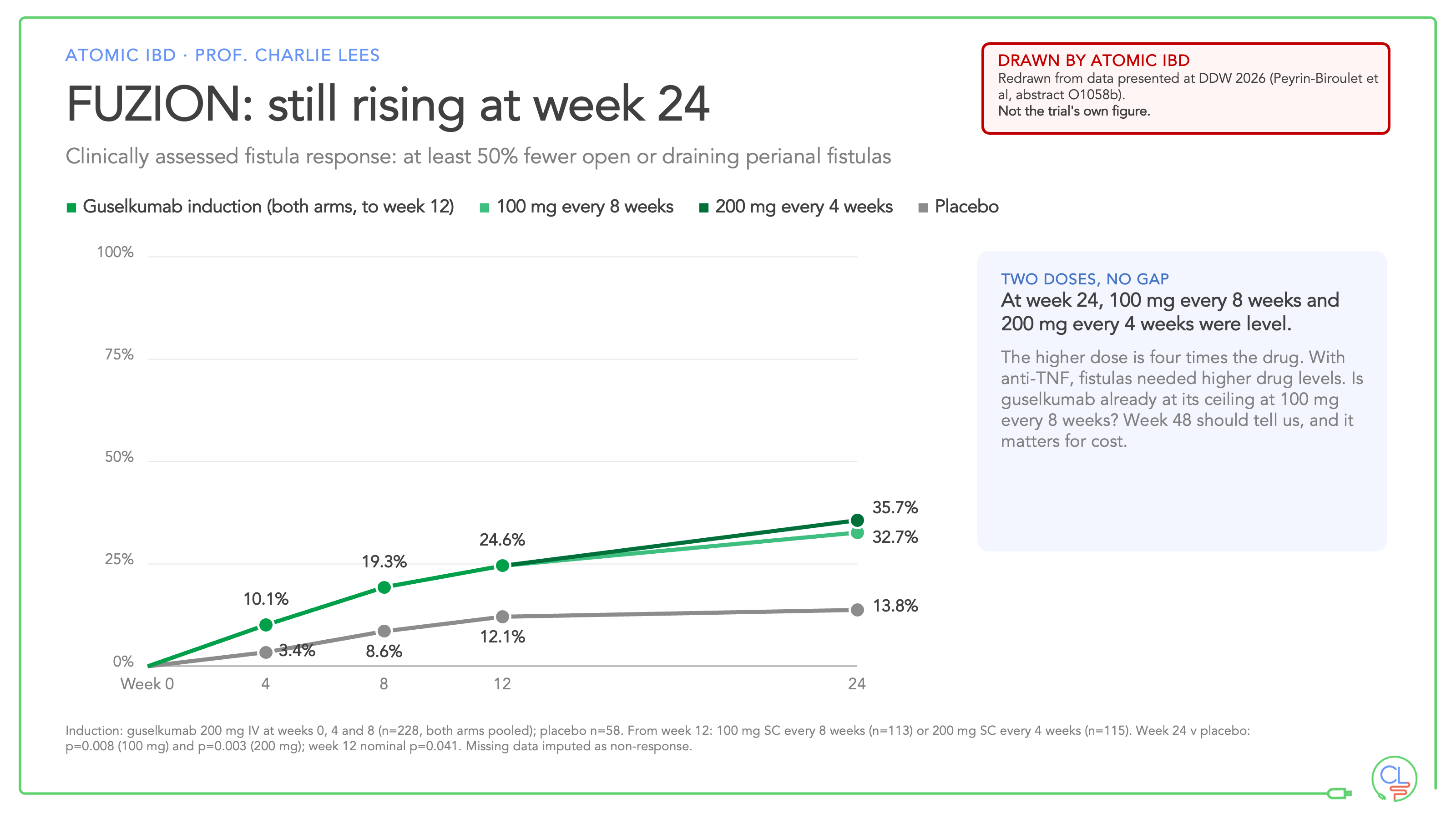
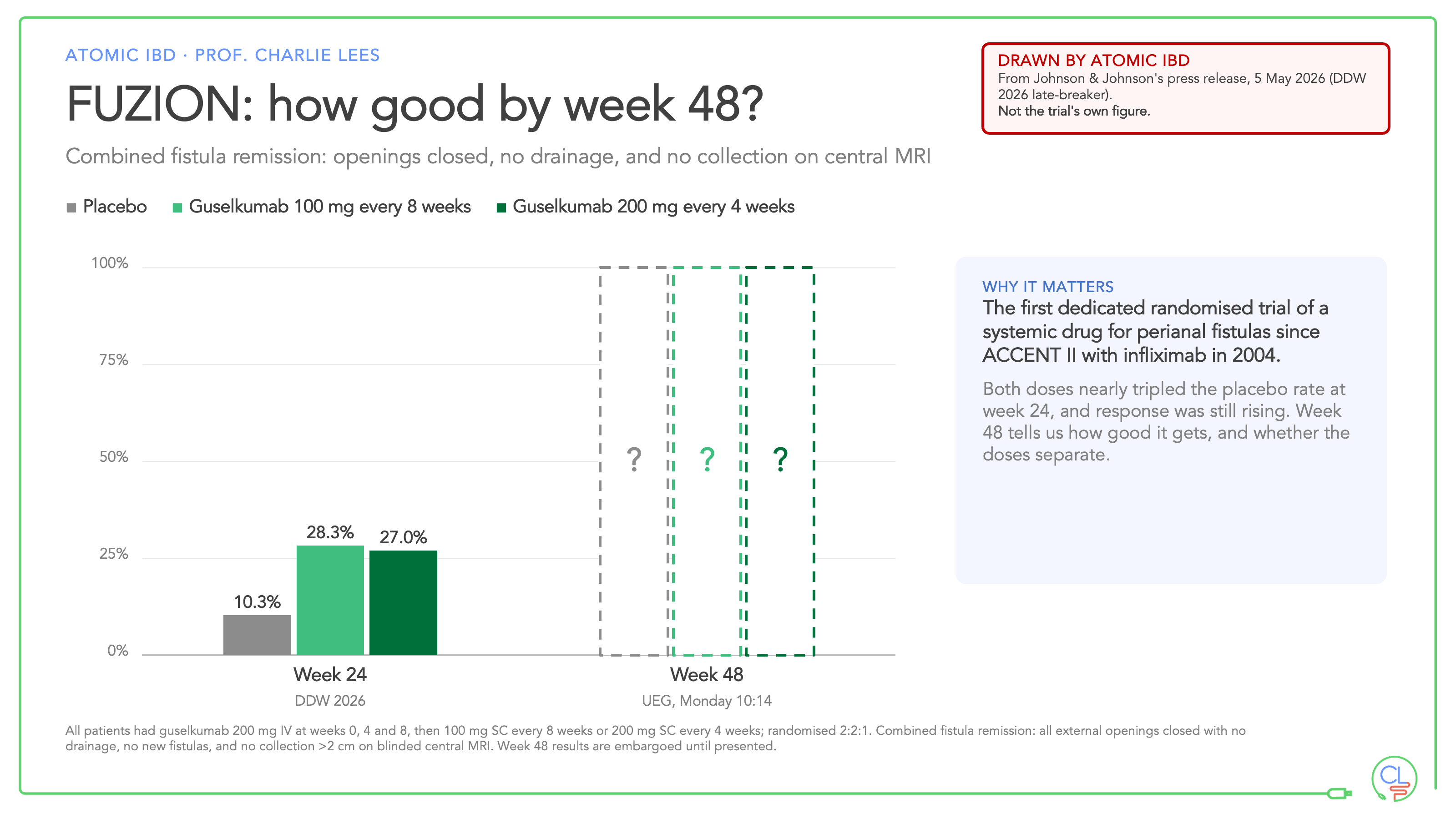
At week 24, shown at DDW in May, fistula response was still climbing on guselkumab and flat on placebo. 27% to 28% reached the primary endpoint of combined fistula remission (openings closed, no drainage, and no collection on central MRI), against 10% on placebo.
The most striking thing to me was how identical the two dosing arms were. 200 mg every four weeks is four times the drug of 100 mg every eight weeks, yet at week 24 they sit on top of each other: 33% against 36% response, 28% against 27% combined remission. That runs against the prevailing narrative that more is better, especially in perianal Crohn’s. With anti-TNF we learned that fistulas need more drug, and in our own Edinburgh data fistulas healed in patients with higher drug levels.
Giving more of a biologic rarely costs anything in safety. But for many of us it has big cost implications. So is guselkumab already at its ceiling at 100 mg every eight weeks? Week 48 will tell us whether the doses pull apart.
Obefazimod: the maintenance year
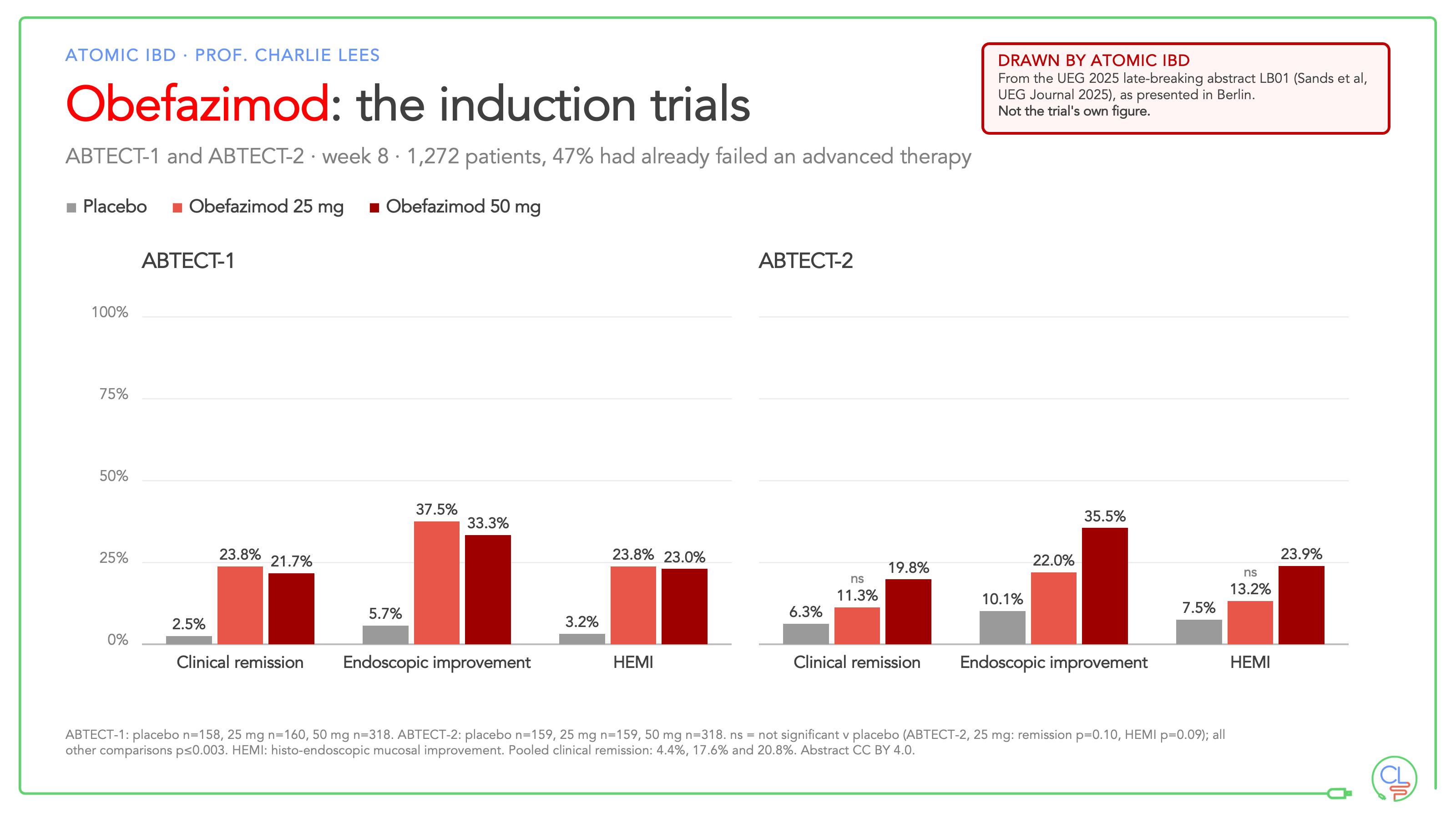
Then at 10:50 in D3, obefazimod. We saw the ABTECT induction data as late-breakers at UEG in Berlin last year: two trials, 1,272 patients, almost half of whom had already failed an advanced therapy. Remission on 50 mg was 20% to 22% at week 8, against 3% to 6% on placebo. The 25 mg dose missed in ABTECT-2.
This is the first presentation of the 44-week maintenance data, in 580 people who responded to induction and were re-randomised. So far we’ve had the June press release, and the abstract has been online since the embargo lifted on 26 September. It looks very exciting. 51% were in clinical remission at week 44 on either dose, against 10% on placebo. Endoscopic remission was 48% on 50 mg. On paper, the endoscopy numbers sit at or above upadacitinib’s in U-ACHIEVE, with the usual warning about comparing across trials.
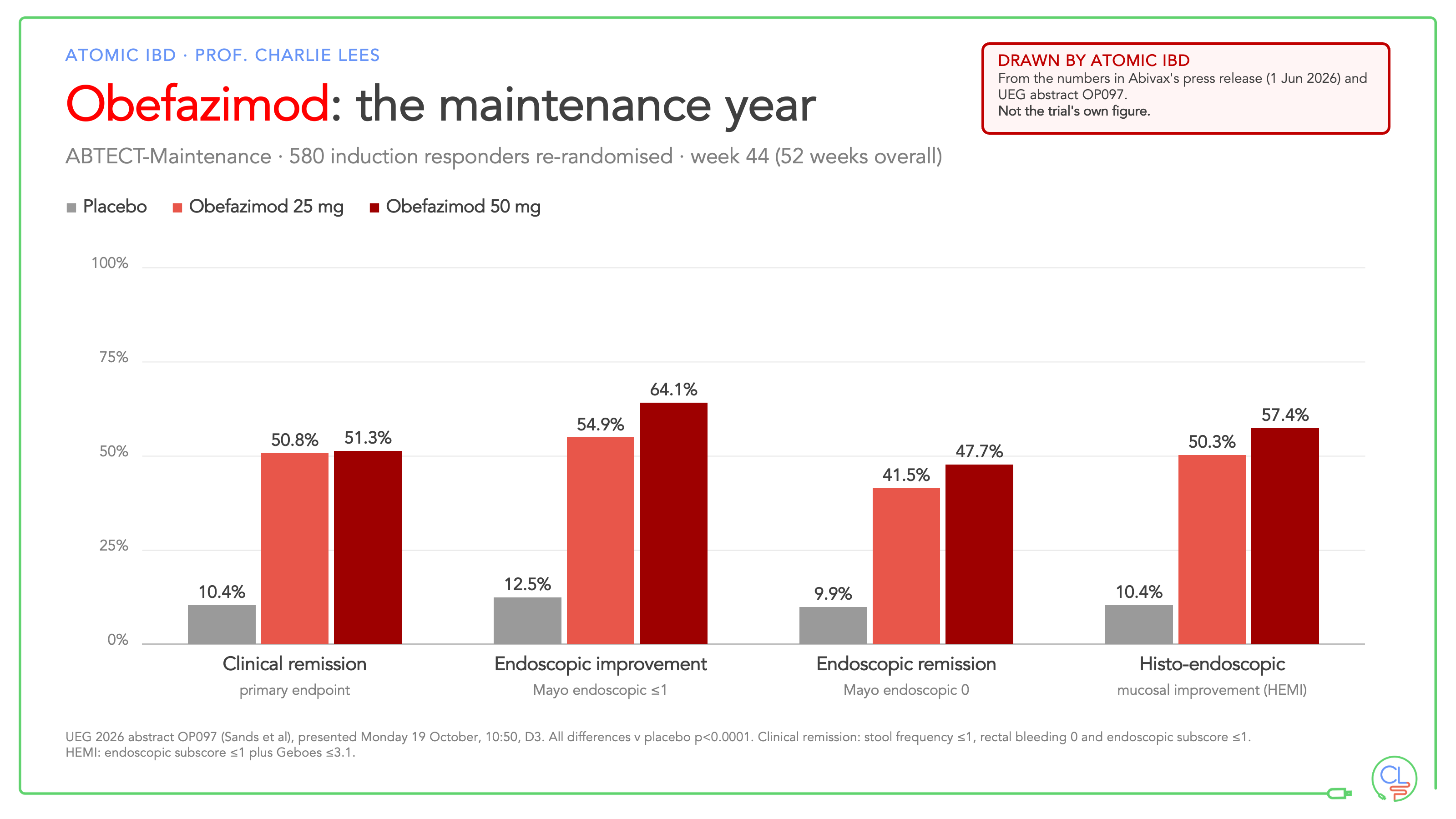
Even patients who hadn’t responded to induction reached 37% remission at week 44 if they stayed on 50 mg. Side effects were more common on 50 mg (72% reported at least one, against 50% on placebo), and the press release listed three malignancies other than skin cancer, all on 50 mg (prostate, breast and colonic dysplasia), all judged unrelated by investigators. The full safety data deserve a careful look. Abivax plans to file with the FDA this quarter.
On Tuesday at 12:20 in B3, the same data split by whether patients had already failed advanced therapies. That’s what decides where it sits in the sequence.
PROFILE at five years
We’ve seen it at ECCO and DDW, and it’s now published in full. But it’s the only IBD Top Abstract at UEG (Monday 11:30, A2), and it deserves the room.
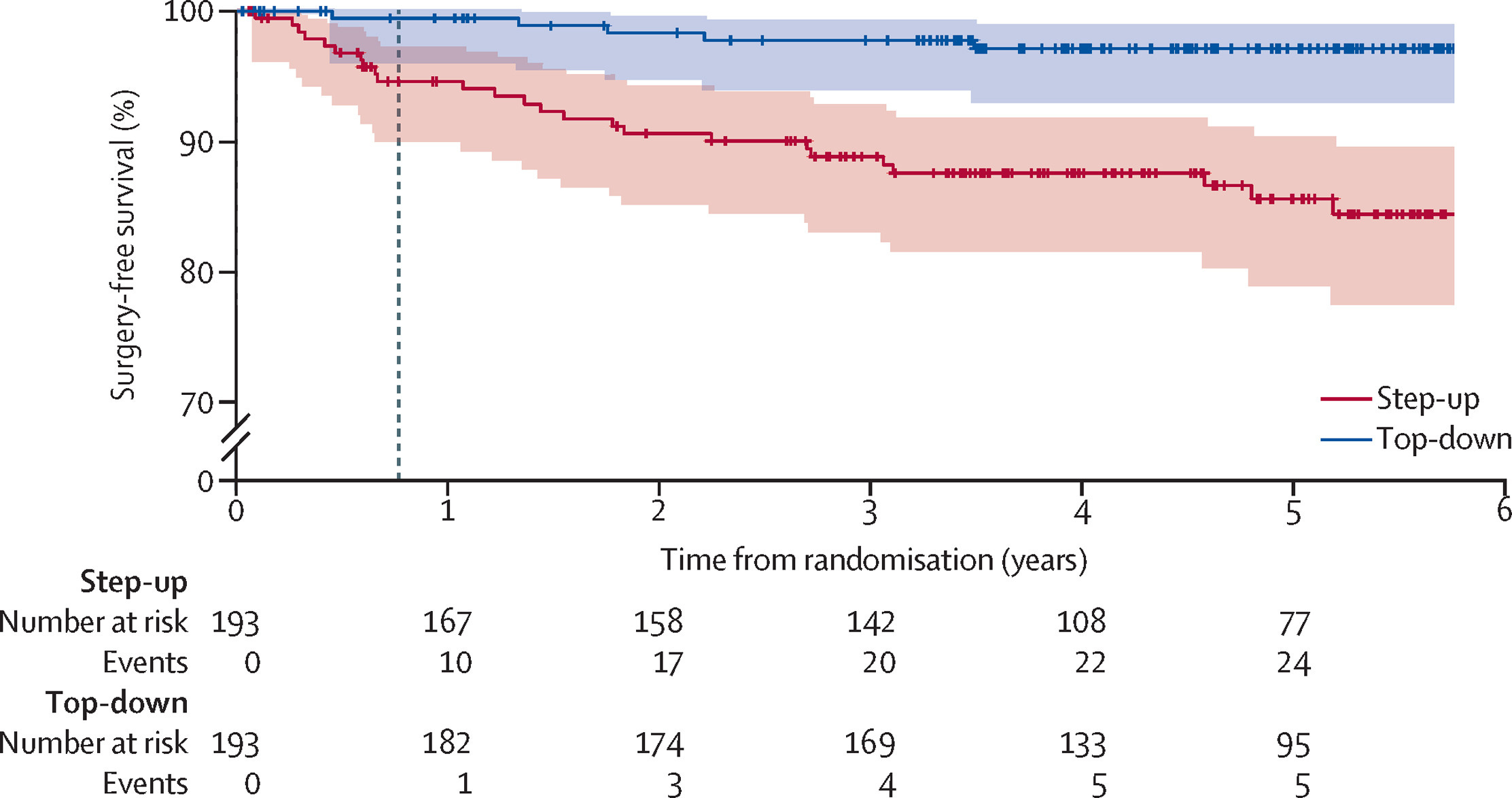
Five years on, 13% of people randomised to step-up had needed Crohn’s surgery, against 3% with top-down infliximab from diagnosis (adjusted hazard ratio 5.2). Treat nine people top-down to prevent one operation. Hospital admissions roughly halved, from 21% to 11%, and progression to stricturing or penetrating disease fell from 17% to 7%. Even accelerated step-up, with anti-TNF started within a year, didn’t catch up.
As I wrote in the pipeline piece, biosimilars let us go top-down in Edinburgh ten years before PROFILE. Now there are five years of randomised data behind it.
New molecules to watch
Emvistegrast, an oral α4β7: first randomised data (Monday 10:21, late-breaker)
ABBV-466, AbbVie’s dual-targeting therapy: risankizumab (anti-IL-23) plus an anti-α4β7 antibody, in Crohn’s (Monday 10:07, late-breaker)
Tuesday 08:30 in the UEG Forum, one hour: icotrokinra (oral IL-23 receptor peptide), mufemilast (oral PDE4), afimkibart and duvakitug (anti-TL1A), OD-001 (oral RIPK2) and ALTB-268 (anti-PSGL-1)
PALI-2108, a gut-targeted PDE4, in stricturing Crohn’s (Sunday 15:40, B3)
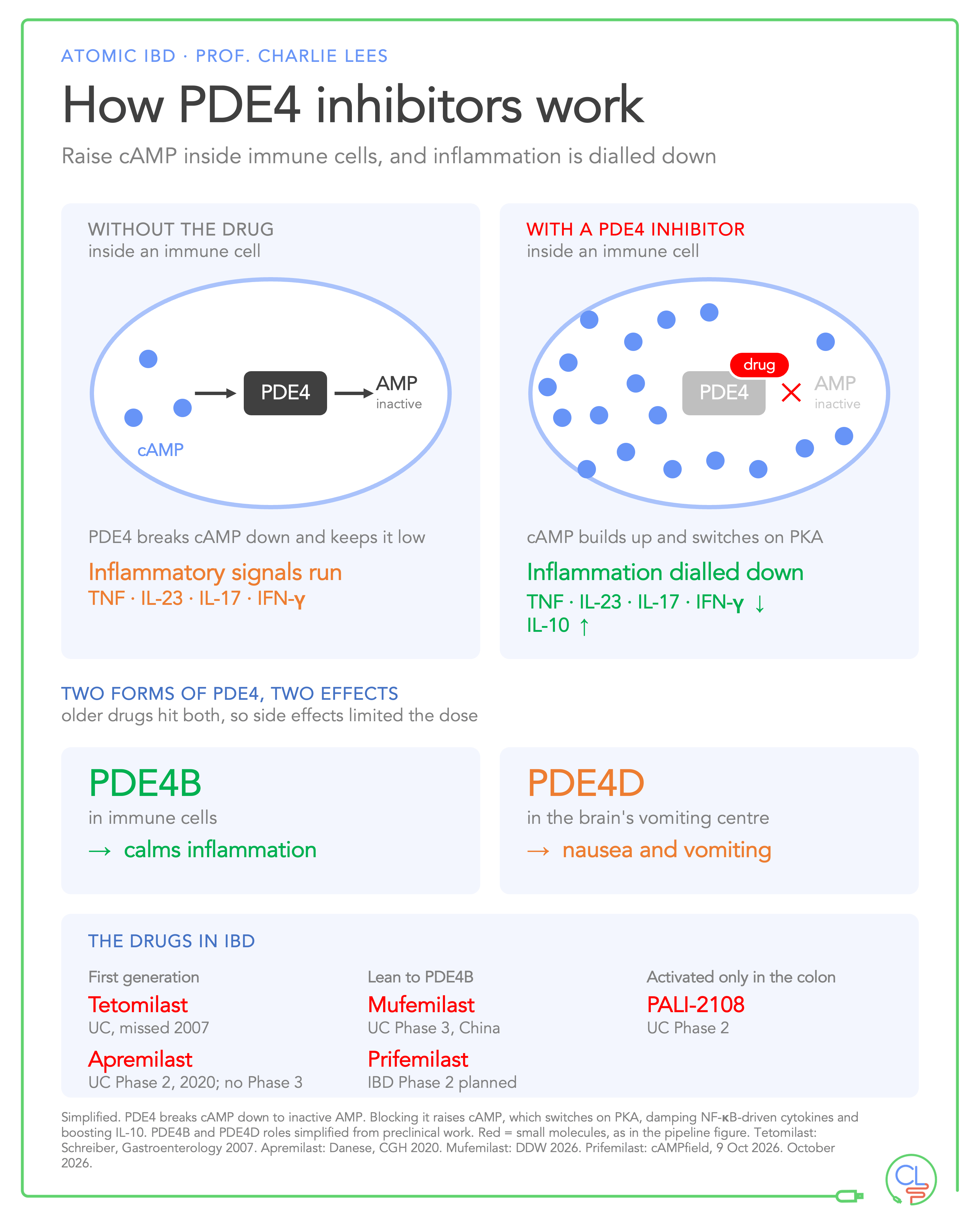
The PDE4s are back. PALI-2108 is designed to be released in the ileum and colon, and its Sunday abstract is tiny: five people with stricturing Crohn’s, 14 days, open label. But SES-CD fell from 8.0 to 4.2, and nobody had nausea, vomiting or diarrhoea, the side effects that have always held the class back. Mufemilast’s 24-week extension follows on Tuesday at 08:40.
Seen already, and not there
DUET returns as refractory subgroups (Tuesday 11:30, B3), not new headline data.
And there’s no Phase 3 anti-TL1A efficacy. Merck says it will show tulisokibart’s induction-only Phase 3 win alongside its induction-and-maintenance study, which is still running. Afimkibart and duvakitug report later. So UEG gets Phase 2 updates on the class, plus a run of posters on how each antibody binds TL1A. The companies are already arguing about differentiation.
And me
On Monday at 11:50 in A1, I’m asking whether nutrition is the missing link in long-term IBD management. It picks up where PREdiCCt left off. Our Gut paper at the start of this year followed 2,629 people with IBD in remission, across 47 UK centres, for a median of four years. In UC, the highest meat intake was linked to nearly twice the risk of an objectively confirmed flare. Ultra-processed food, fibre and polyunsaturated fats showed no consistent link. Diet may matter more for some patients than others, and that’s where the next questions are.
There’s more from PREdiCCt on the way: papers on psychosocial factors and flare, on women’s health, and on the gut microbiome.
If you’re there, come and say hello. I’ll post the results as they land.
Edinburgh IBD is live.
edinburghibd.com is the new home for my team: researchers, clinicians and patient partners working as one, writing the next decade of IBD care by bringing together long-term patient data, clinical expertise and lived experience. You’ll find our research programmes, the trials recruiting now and the people behind them. It’s a big moment for the team, and I’m proud of it.
Times are CEST, from the UEG Week 2026 Final Programme (8 October). Check the app for late changes. Late-breaker results are embargoed until presented, and nothing here quotes them.
Absolutely fantastic work putting these together.
An impressive guide to navigating the upcoming UEG programme—saving this! And I won’t miss your talk.