


The transformations in IBD care we have witnessed over the last two decades are thanks to three things: effective drugs, treat-to-target strategies and education. The biggest challenge today is implementation.
UEG Week 2026 gave us not only a first look at a wide range of new therapies for IBD (more on those to come), but also a big update on treat-to-target. First VERDICT, the first trial to compare treatment targets in UC, and then the launch of STRIDE-III from IOIBD, published the same day. They were presented back to back, and they belong together. VERDICT asks which target we should treat UC to. STRIDE-III asks which targets count, and what to do when we miss them.
Here I review both, and what they mean for the IBD clinic today.
VERDICT
VERDICT, led by Vipul Jairath, is the first trial to randomise patients with UC to different targets. The full paper is still to come, so these are first thoughts from the presentation.
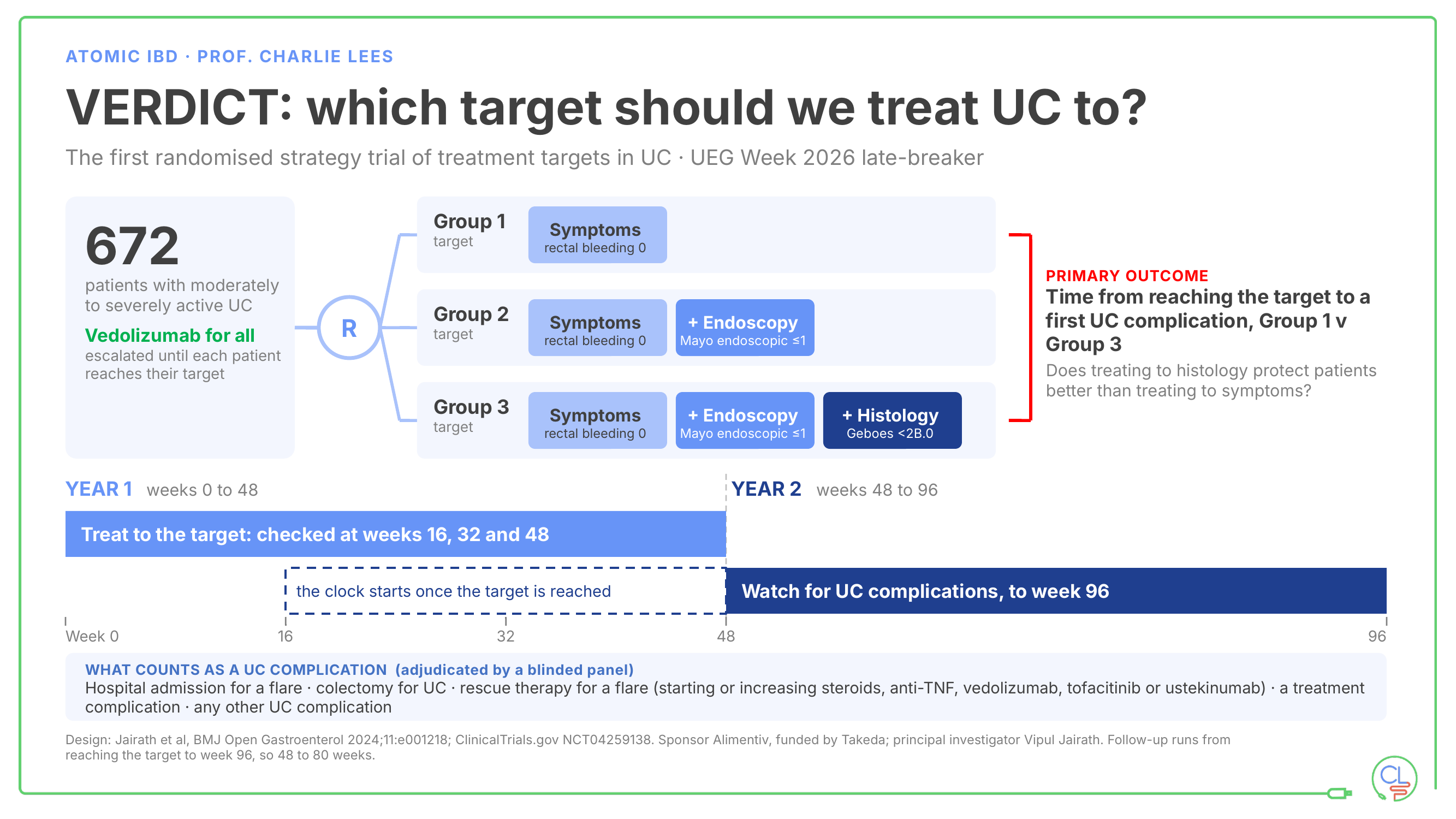
672 patients with moderate to severe UC were randomised to one of three targets, on a vedolizumab-based algorithm stepped up (to 4-weekly dosing if needed) until the target was reached. Endoscopy and histology were read centrally.
Group 1: symptoms
Group 2: symptoms + endoscopic remission (Mayo endoscopic subscore 0–1)
Group 3: symptoms + endoscopic + histological remission (Geboes <2B.0)
The primary outcome was time to a UC complication, for up to 80 weeks after reaching the target.
At baseline, mean age was 41, with eight years of disease, a Mayo score of 8.7, nearly two-thirds Mayo 3, almost half on steroids and a fifth after an advanced therapy. By week 48, 74%, 56% and 52% of groups 1 to 3 had reached their targets.
Treating to endoscopy made a big difference. 22% of group 1 had a UC complication, against 7% in group 2 and 9% in group 3. The primary comparison, group 3 against group 1, gave a hazard ratio of 0.33 (95% CI 0.17 to 0.67). Group 2 against group 1 gave 0.30 (0.14 to 0.64). In the Q&A, Vip said the effect was greater still at Mayo 0 (data not shown). About half the complications were rescue therapy for a flare; only one was an admission and none a colectomy.
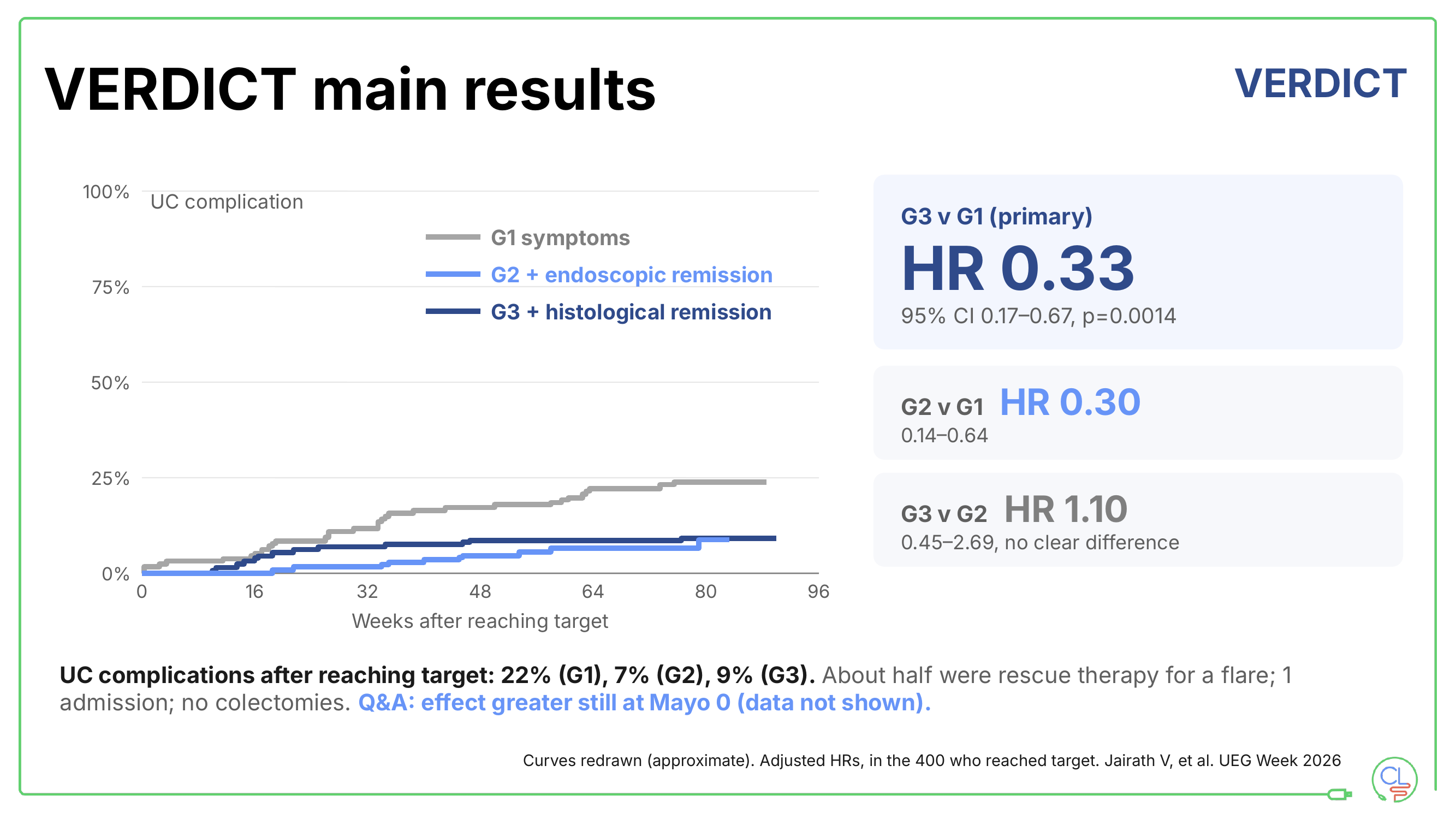
But there was no clear additive benefit from histology: group 3 against group 2 gave a hazard ratio of 1.10 (0.45 to 2.69). Read that with one more number. 79% of group 2 (99 of 125) were also in histological remission when they reached their endoscopic target. So the two groups were clinically similar, and the comparison rested on about one in five.
And endoscopy was read centrally. When it is, Mayo 0 is usually free of neutrophils: 84% in LUCENT and over 90% in QUASAR. Local reading is another matter. In OCTAVE, central readers confirmed only 38 to 46% of local Mayo 0 calls.
We do not have the equivalent data on paired centrally read endoscopy plus histology in UC patients not on advanced therapy (as far as I know). That might matter in the real world. We know histological inflammation carries long-term risk, including cancer. VERDICT covers only one to two years. Most of that long-term evidence comes from scoring old H&E slides, recut from paraffin blocks if needed. You can’t go back and re-read an old endoscopy the same way.
So ... with endoscopy read well, histology added nothing we could detect.
Uma Mahadevan asked on X whether this means we should stop taking random biopsies to check histological healing. Will I? No. I take them every time I scope a patient with UC, and VERDICT doesn’t change that. Vip said as much himself on X. He sees histology as the target, given the size of the hazard ratio against symptoms. But in a vedolizumab treat-to-target trial with central reading, endoscopy tracked histology closely, so endoscopy is probably enough in that setting. Biopsies still give the complete picture and dysplasia information, so he will keep taking them. Maria Abreu was blunter: “I would need therapy to stop myself from taking segmental biopsies.”
My reasons are simple. First, I read my own scopes, and as Michael Chiorean pointed out, histology is harder to fool than an endoscopist looking at mild erythema and friability. Second, Mayo 1 covers a lot of ground, and histology tells me where in it a patient sits. Third, I want to know about dysplasia, and persistent histological inflammation is one of the clearest risk factors we have for it. Fourth, a biopsy today is the baseline for every scope that follows.
What VERDICT changes is what I do with the result. If a patient is well and in endoscopic remission, persisting histological activity is a reason to optimise and watch more closely. On its own it isn’t a reason to switch. That is exactly where STRIDE-III lands.
But in the debate on histology v endoscopy, we must not lose sight of just how important VERDICT is. It is very clear that treating to endoscopic healing makes a huge difference to outcomes that matter to patients.
There is a lot I’m curious to see in the full paper:
What happened to the 272 who never reached their target?
G2 split by Mayo 0 v Mayo 1, and complications in each
When did each group reach target? Same result if timed from vedo start?
How many were on q8w v q4w vedo at target?
Calprotectin at wk 48 in those at target
How was flare defined (investigators were unmasked)?
Results by prior therapy: biologic-naive v exposed
Core phenotypes by group, including extent
And of course, whether calprotectin is a good enough proxy in the real world. More on that below.
STRIDE-III
STRIDE-III takes the wider view: which targets count, when to check them, and what to do when they are missed. It is a long, careful review, but its core fits on one figure and one table.
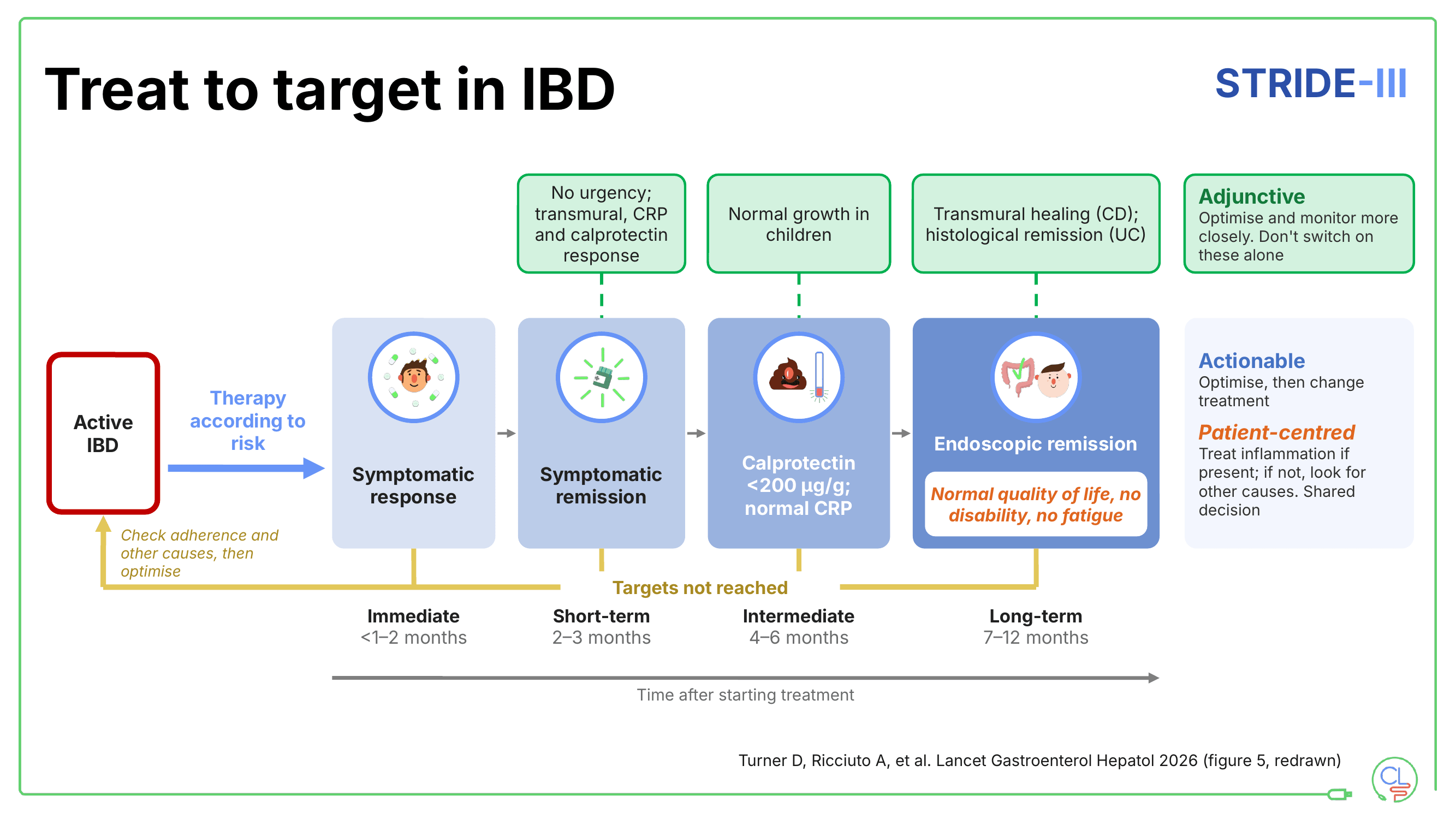
The big idea is a good one. Targets are now sorted by what you do when you miss them.
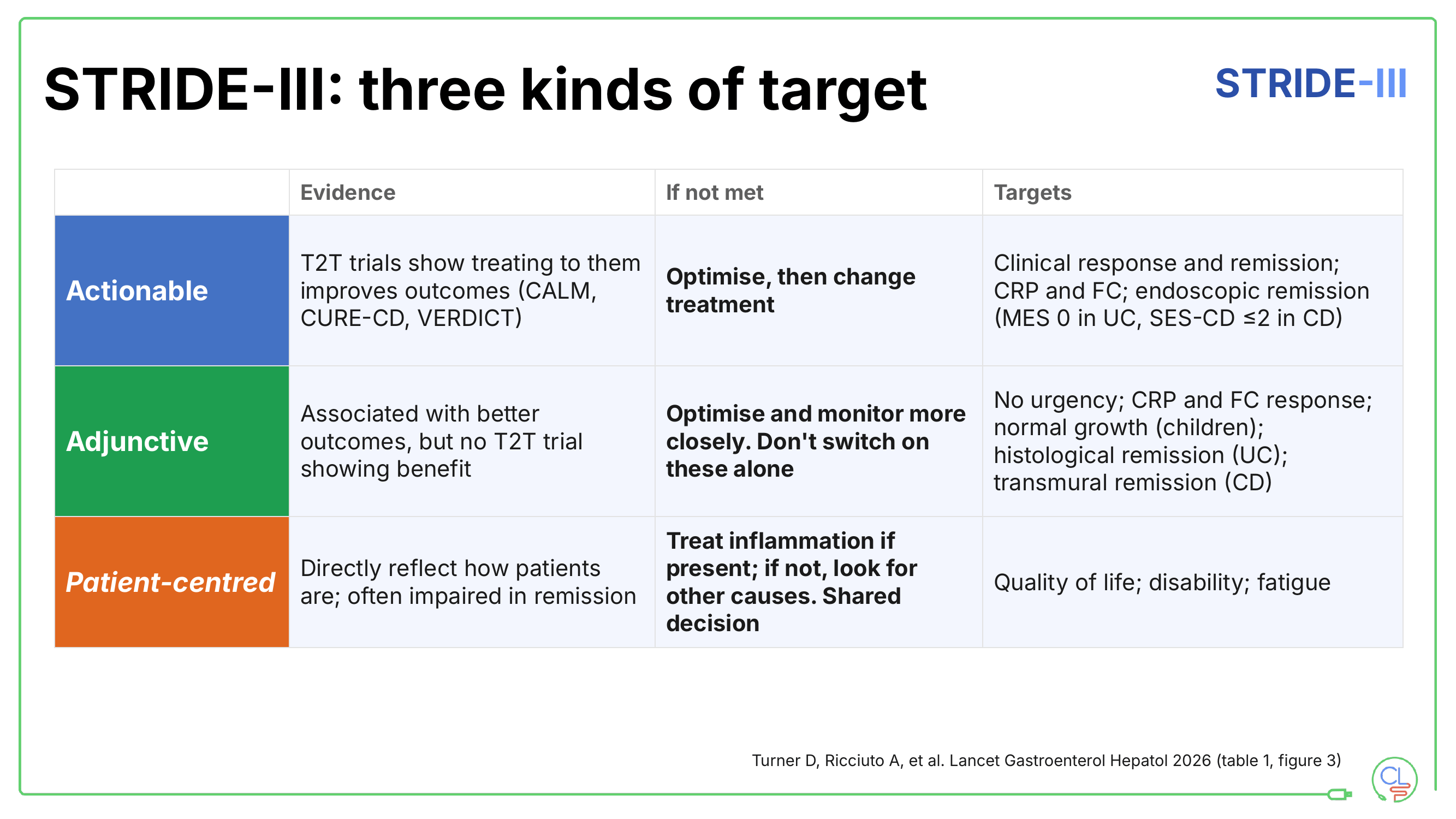
Actionable targets (clinical response and remission, CRP and calprotectin, endoscopic remission) justify a change of treatment once the current one has been properly optimised.
Adjunctive targets guide optimisation and closer monitoring, but are not on their own a reason to switch.
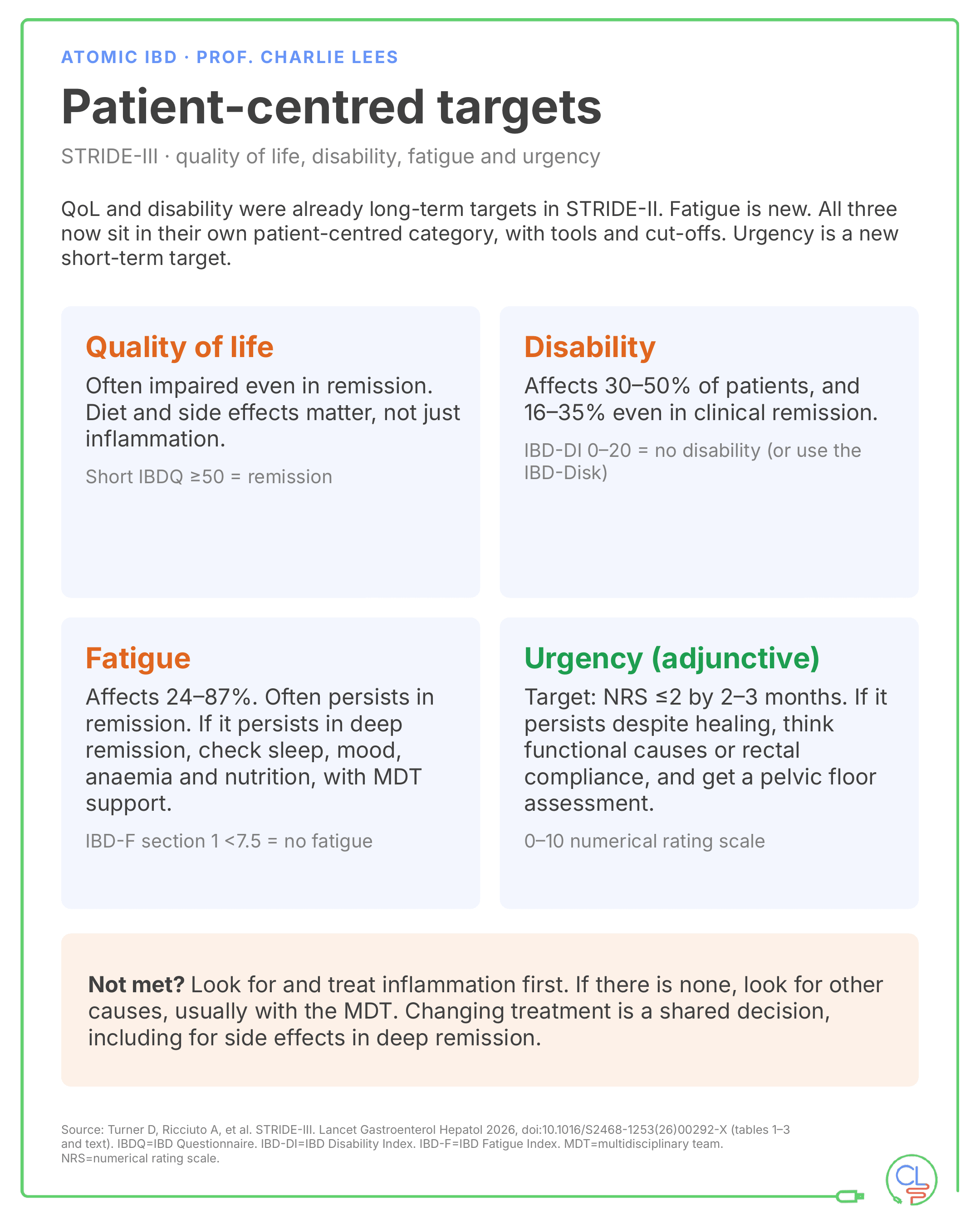
Patient-centred targets (quality of life, disability and fatigue) are handled by shared decision.
That sorting gets a lot right.
Calprotectin gets sharper numbers (STRIDE-II said 100–250 µg/g): under 200 µg/g is the acceptable range, under 100 µg/g goes with transmural remission in Crohn’s and histological remission in UC, and 100 to 200 is a grey zone, so test serially.
Endoscopic remission in UC is now Mayo 0, with Mayo 1 accepted as an interim target, when clinical and biochemical remission back it up.
Histology in UC and transmural healing in Crohn’s become adjunctive long-term targets. That fits the evidence, VERDICT included. Histology is not a target in Crohn’s at all.
Urgency is new: no urgency (NRS of 2 or less) is a short-term target, but an adjunctive one. If it persists despite healing, think functional causes and consider a pelvic floor assessment.
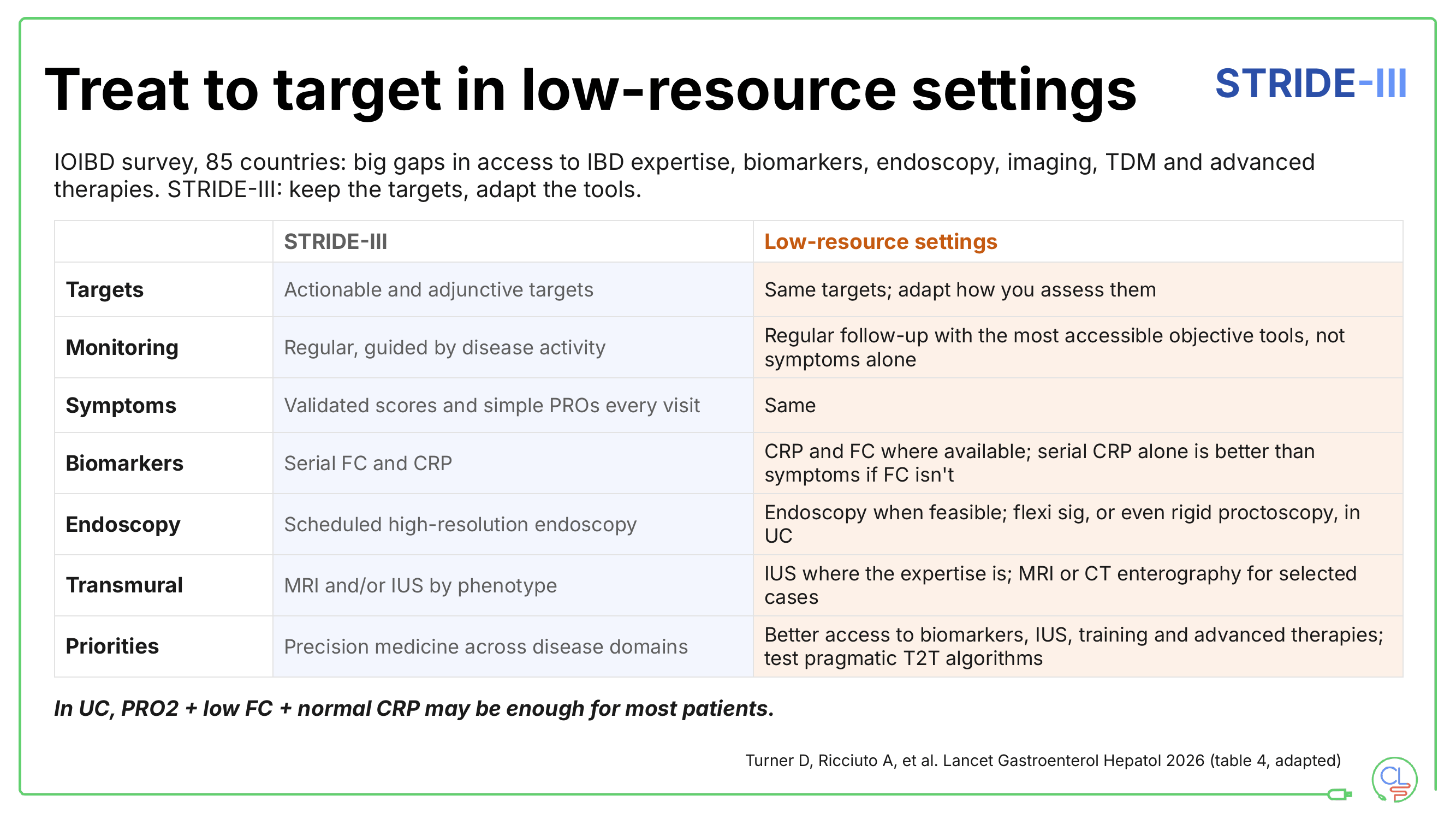
In resource-limited settings the targets stay the same and only the tools change.
One caveat on scope: STRIDE-III covers medically managed luminal disease, not perianal disease, pouchitis, extraintestinal manifestations or postoperative care.
Patient-centred targets
For patients reading this, this is probably the most important part.
If these targets are not met, look for and treat inflammation first. If there is none, more anti-inflammatory treatment isn’t the answer. Look for the other causes (anaemia, nutrition, sleep, mood, side effects), with support of the full multi-disciplinary team where available. Any change of treatment is then a shared decision, and STRIDE-III is clear that a drug can be changed for side effects even in deep remission.
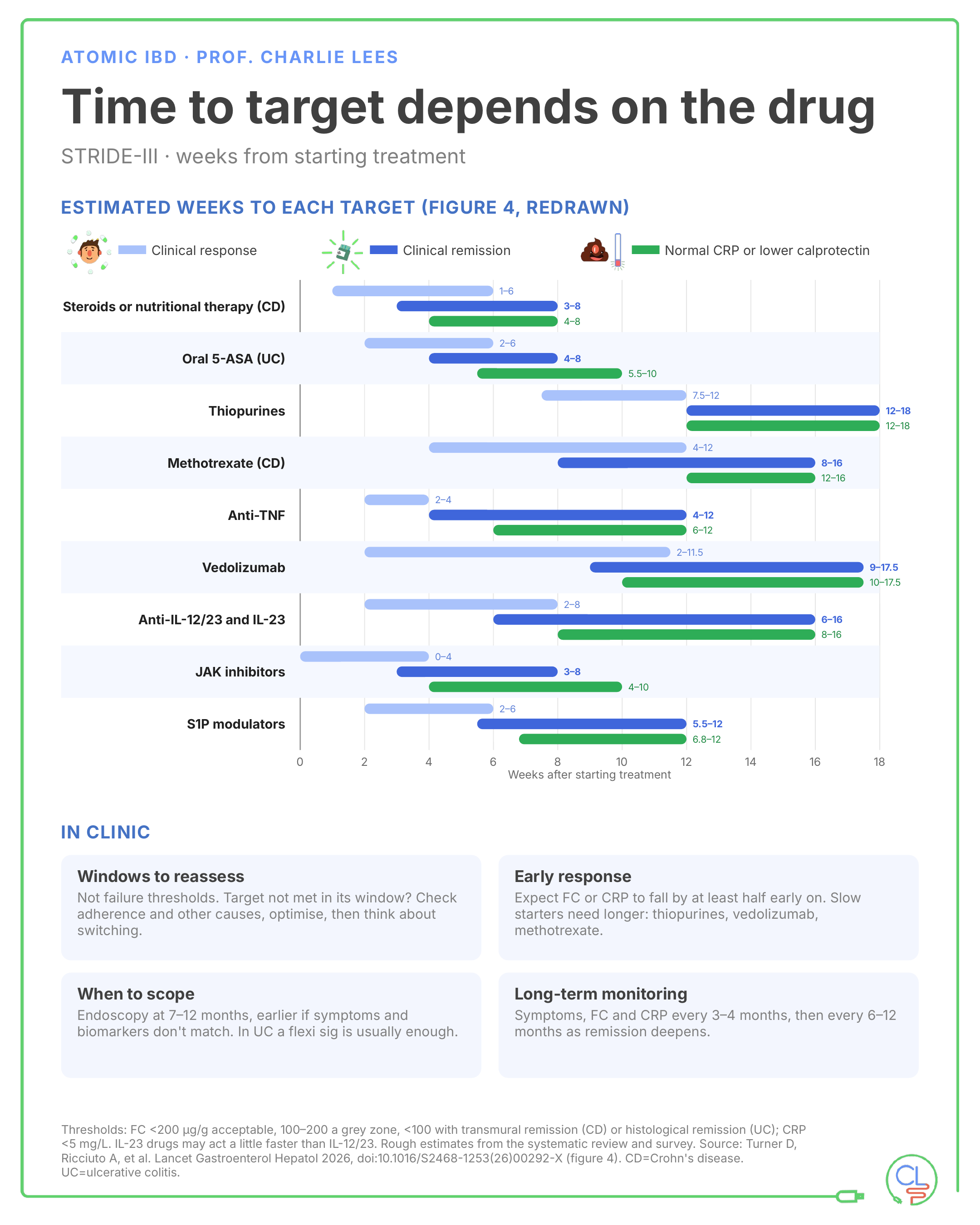
Time to target by drug
If you keep one figure from this piece for clinic, make it this one: how long each drug should take to reach response, remission and normal biomarkers. These are windows to reassess, not hard failure points.
Low-resource settings
I’ve seen first-hand on my travels the huge challenges faced by clinicians and patients in low-resource settings, from South America to Africa to the Indian subcontinent and beyond. So it is great to see STRIDE-III give a pragmatic version of treat-to-target for these settings: keep the targets, adapt the tools.
Look out for the Lancet Commission on global IBD, presented at ECCO 2026 (I’m a contributing author).
Putting them together
So what does this mean for the clinic today? In UC, treat to endoscopic remission, ideally Mayo 0, not to symptoms. VERDICT is the trial behind that call in STRIDE-III. Treating to endoscopy beat treating to symptoms, so endoscopic remission is actionable. Adding histology gave no extra gain, so histology is adjunctive. It stays in because it is still linked to outcomes, mainly within Mayo 0–1.
Back to my calprotectin question. In UC, the biomarker treat-to-target trials (OPTIMISE, DEAR, Lasson) didn’t show clinical benefit, but STRIDE-III makes calprotectin and CRP actionable in UC anyway, on consensus, observational data and CALM in Crohn’s. Whether calprotectin can stand in for a scope in the real world is still open.
In Crohn’s, transmural healing is adjunctive because no one has yet treated to it in a trial. VECTORS (phase 4, ongoing) is testing whether targeting IUS response or transmural healing, on top of clinical and biomarker remission, improves endoscopic outcomes.
In Edinburgh we have used calprotectin as a proxy for mucosal healing for many years, partly because of capacity constraints in endoscopy and the sheer number of IBD patients we look after. We have also built confidence in the lab assay, which we have used for over 20 years. Using the same assay throughout lets us look at calprotectin over time, rather than at single values. That is what we do in clinic (to an extent) and in my research group, modelling trajectories of inflammatory behaviour. Across IBD we found distinct calprotectin and CRP trajectories, and the calprotectin patterns were largely reproduced in a Danish national cohort (CGH 2026). This work continues in our Longitude programme. More at edinburghibd.com.
What next
The final paragraph of STRIDE-III is noteworthy. Future versions could move beyond a simple yes or no on hitting a target, towards longitudinal, multidomain approaches, with AI tools and multi-omics biomarkers in the mix. Which brings me back to where I started: implementation. That’s where I think the next big questions are: how we hold these targets over a lifetime, and how we deliver them for whole populations, not one patient at a time.
And that’s a great introduction to our work with SENTINEL, with much more to come.