Follow the money (and the footnotes): IBD pharma in 2026
What happened away from DDW and UEG, from the post-2023 deal rush to the readouts we still haven’t seen.

Most IBD news no longer breaks in a congress hall. Having covered the headline readouts from DDW and UEG already, what strikes me is how much of the real action this year happened everywhere else: in deal announcements, in quarterly investor decks, in a London court filing, and in one case in five months of complete silence.
Step back from the individual trials and one number defines where the field is. Thirteen IBD deals worth $500m or more since the start of 2023, against nine in the fifteen years before, and six in 2026 alone.
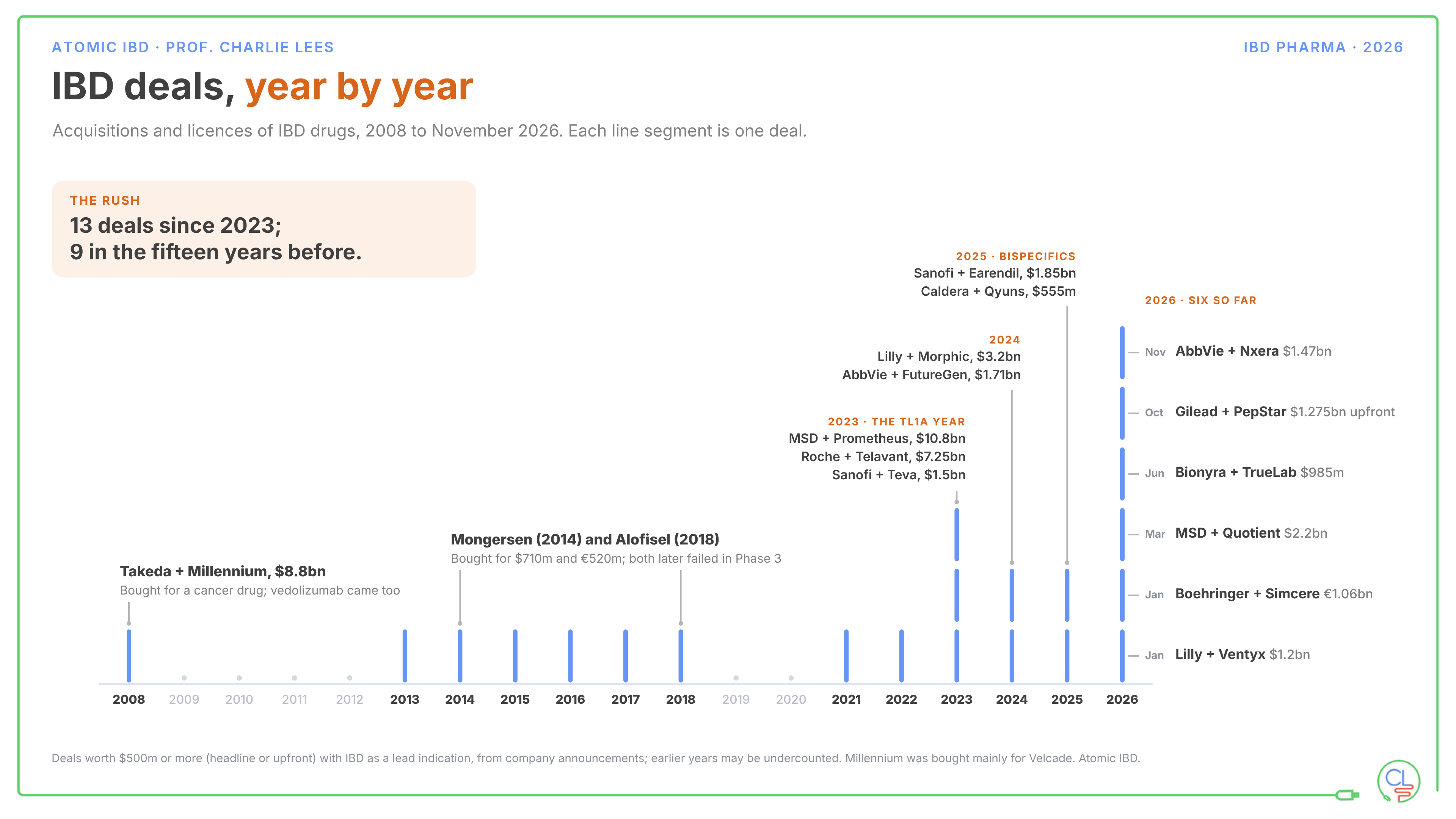
1. Follow the money, and read past the headline
The big pharma shopping list rotates about every eighteen months. In 2023 it was anti-TL1A, led by MSD’s $10.8bn buyout of Prometheus and Roche’s $7.1bn for Telavant, while Sanofi and Teva reached the same target with duvakitug for $500m upfront. By 2025 the money had moved to bispecifics. In 2026 the buyers have turned again, towards oral peptides, somatic genomics and gut-restricted barrier drugs.
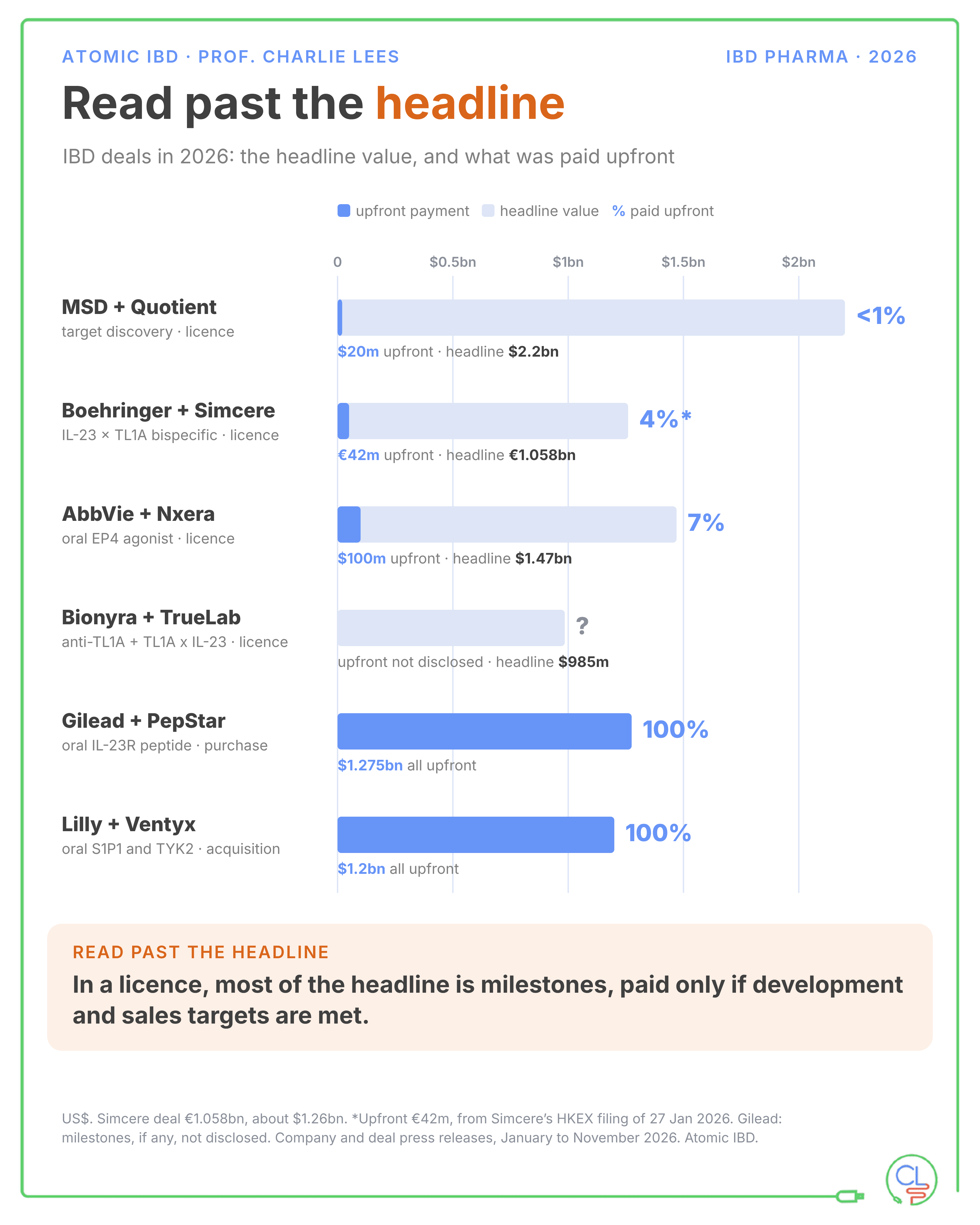
The split that matters is between buying a company and licensing a molecule. Buy one and the money is paid at close. Licence one and most of the headline is a promise. MSD’s “$2.2bn” target-discovery licence with Quotient, which mines the somatic mutations that build up in diseased gut tissue, was $20m upfront, under 1%. Boehringer Ingelheim’s deal for Simcere’s preclinical IL-23 × TL1A bispecific was €42m upfront out of up to €1.06bn, about 4%. AbbVie’s licence for Nxera’s gut-restricted EP4 agonist, aimed at mucosal healing and barrier repair, put down $100m of $1.47bn. Quotient and Nxera are both bets away from the immune cell.
Set those against two where the cheque was the whole story: Lilly buying Ventyx outright for about $1.2bn in January, for an oral S1P1 and an oral TYK2, though Lilly’s own announcement led on its NLRP3 programmes, and Gilead paying $1.275bn upfront for PepStar in October for a Phase 1 oral IL-23R peptide, before a single clinical dataset has been published. And one company chose not to sell at all: Protagonist turned down reported takeover talks with J&J last autumn and kept a 6 to 10% royalty on icotrokinra instead, which, if the investment bank Jefferies is right that the drug peaks near $10bn a year, is a considerable bet on itself.
2. Two routes to breaking the ceiling
I have spent much of the autumn writing about combination therapy here: two drugs versus one, then the IBD polypill and the subcutaneous plus oral pairings. This is the other side of that story. Almost every molecule behind this year’s deals is being built for combination, and the field has split into two routes.
The oral route, and the polypill. J&J’s oral IL-23R peptide icotrokinra was approved for psoriasis in March as Icotyde, the first of its kind, published ANTHEM-UC in the NEJM in October and is moving through Phase 3 in IBD. Gilead’s CMO has already floated pairing PepStar’s peptide with Gilead’s own oral α4β7 inhibitor, emvistegrast, which puts two compartments of the polypill under one roof.
Long-acting antibodies and bispecifics. At least six IL-23 × TL1A bispecifics are now in play, most of them originating in China. Four have western partners or trials: Boehringer and Simcere, Caldera and Qyuns, Bionyra and TrueLab and Xencor. Caldera’s CLD-423 showed a Phase 1a half-life above 40 days this month, which points to subcutaneous dosing every 8 to 12 weeks. Spyre is taking the modular approach instead: separate extended half-life antibodies against α4β7, TL1A and IL-23, all three of which met their Phase 2 primary endpoint this year on histology, rather than on symptoms, ahead of randomised combination arms in 2027. Whether a fixed bispecific matches two separate antibodies you can titrate independently is still an open clinical question.
And one company that stayed independent. Abivax spent January as a takeover target, with the French press reporting that Lilly was preparing a bid of about €15bn. The French finance ministry denied any contact with Lilly, and no offer came. AstraZeneca was reported in March to have exclusive access to the data until 23 March, which Abivax denied the same day as unfounded rumour. ABTECT maintenance in June put week-44 clinical remission at 50.8% and 51.3% vs 10.4% on placebo in the re-randomised responder population, the pre-NDA meeting went well in July, and Abivax is filing by the end of the year while building a US sales team and spending on combination work of its own. For a company that was being circled in January, that is quite a turn. Writing about any of this reliably brings the $ABVX retail crowd into my comments.
3. Big bets, quiet slides, and a 150-day silence
For all the capital going in, remarkably little of the recent deal wave has reached the clinic. Of the nine biggest deals struck for IBD drugs since 2017, exactly one has produced a drug you can prescribe for IBD today, Pfizer’s etrasimod, and that drug dropped its Crohn’s disease programme for efficacy in 2025. A second, icotrokinra, is approved, but in psoriasis.
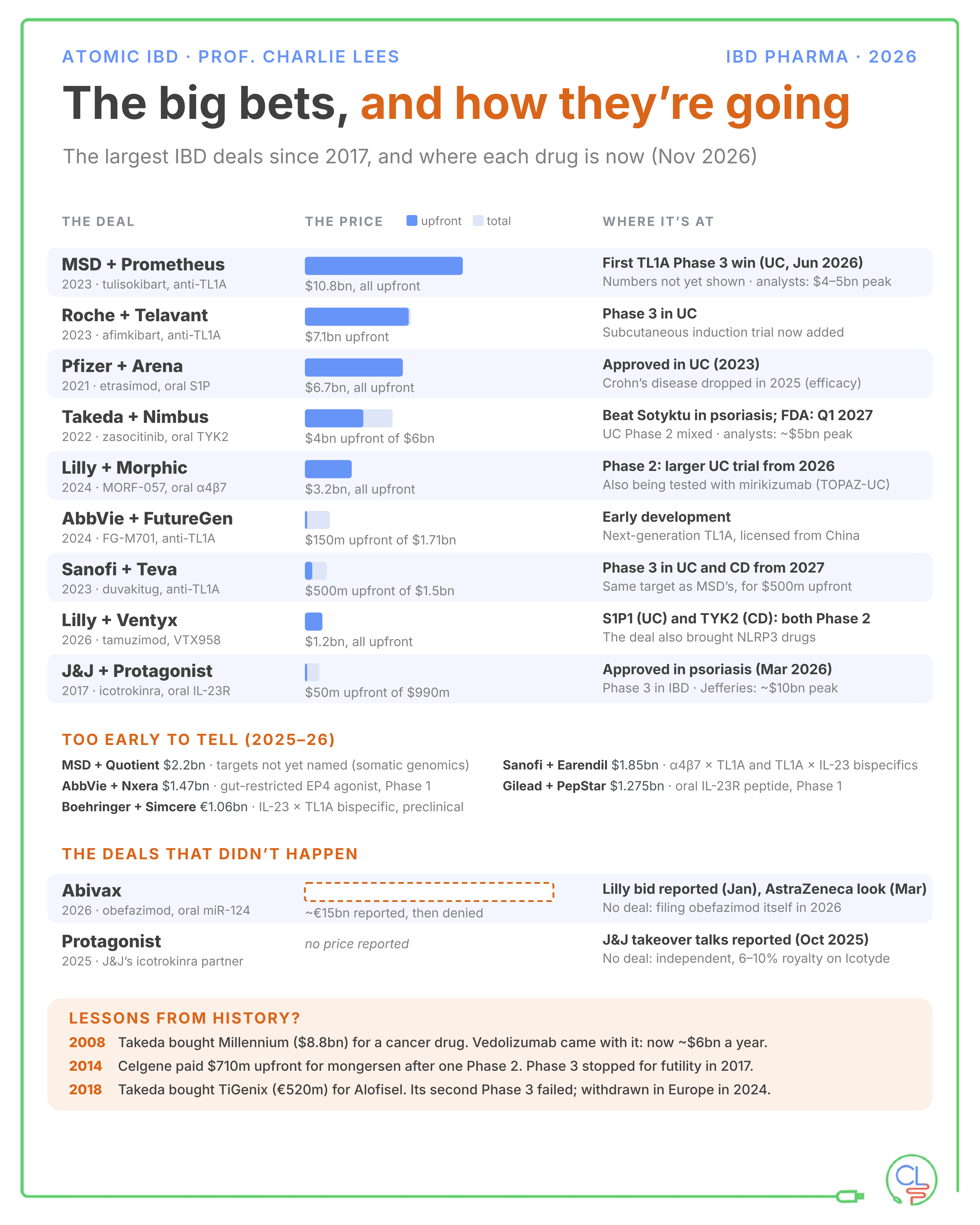
History argues for humility. In 2008 Takeda bought Millennium for $8.8bn, mainly for an oncology drug; vedolizumab came along with it and now brings in close to $6bn a year. Against that, Celgene paid $710m upfront for mongersen in 2014 and the Phase 3 was stopped for futility in 2017, and Takeda paid €520m for TiGenix in 2018, after which Alofisel was withdrawn in Europe in 2024 following a second Phase 3 miss. On signing day nobody could tell the winners from the write-offs.
What’s happening here? Several things at once. There is FOMO, and TL1A is the classic example of it. There is probably some me-too in the bispecifics. There is patent cliff panic, and the positioning that goes with it. There is real strategy behind the oral combinations and the polypill. And there is some genuinely fascinating biology, leading to increasingly targeted therapies that look beyond the immune cell, which is hugely exciting.
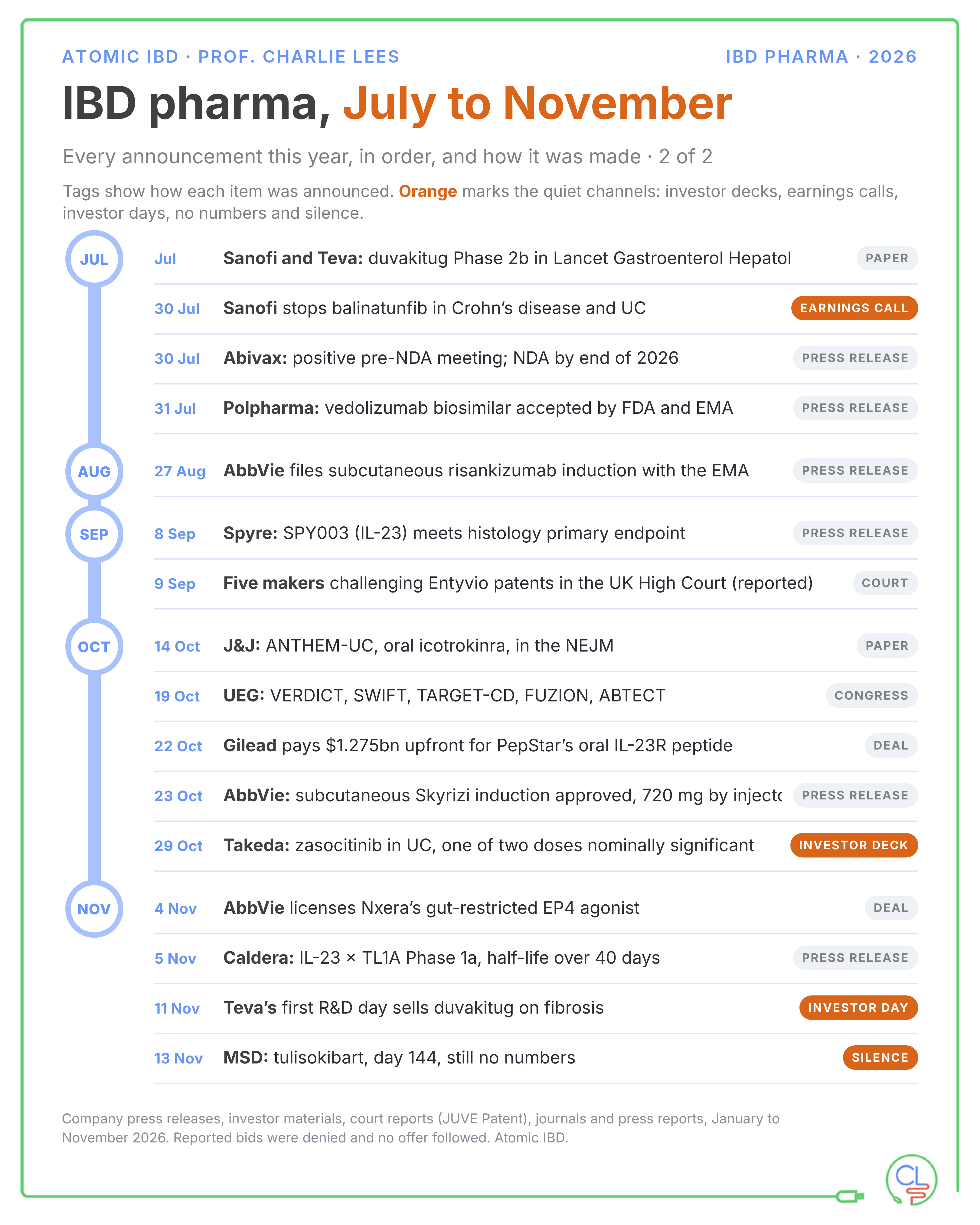
This year also reinforced a reliable rule. Good news gets a press release; disappointing news gets a slide, or silence.
Day 150 with no numbers. On 22 June, MSD announced that tulisokibart met its Phase 3 endpoints in ATLAS-UC, the first win for an anti-TL1A antibody. Five months and a UEG congress later we still have not seen the effect sizes. Holding the induction-only study to present alongside Study 1, which includes maintenance, is defensible. It is still a long wait for the class leader behind a $10.8bn deal, and all the longer while Teva uses its first R&D day in November to sell rival duvakitug on anti-fibrosis, which has not been shown in patients.
Tucked into quarterly updates. Takeda’s TYK2 inhibitor zasocitinib beat Sotyktu in psoriasis and has an FDA decision due in the first quarter of 2027. In UC it reached nominal significance at one of two doses with no dose response, disclosed on a Q2 investor slide rather than in a press release, and Phase 3 plans continue. In July, Sanofi quietly stopped its oral TNF inhibitor balinatunfib in Crohn’s disease and UC during an earnings update, after interim efficacy fell short of internal expectations.
4. Meanwhile in the clinic, and three things for 2027
The deals in this piece will take half a decade to read out. The two changes that reach the clinic soonest came from somewhere else entirely: an approval, and a patent case.
Skyrizi induction at home. In October the FDA approved subcutaneous risankizumab induction in Crohn’s disease, 720 mg by on-body injector at weeks 0, 2, 4 and 8. In AFFIRM (n=274), week-12 clinical remission was 56% vs 30%.
Vedolizumab biosimilars reach the High Court. With Alvotech’s intravenous version accepted by the FDA in June and Polpharma and Fresenius Kabi’s accepted by both the FDA and the EMA in July, five biosimilar makers are now asking the UK High Court to revoke Takeda’s Entyvio dosing-regimen and formulation patents and clear the way for a UK launch. The London trial is set for April 2027, well ahead of 2032, the date Takeda says its US patents run to. We have done this with infliximab, adalimumab and ustekinumab. Vedolizumab is next.
What I’m watching in 2027: MSD’s ATLAS-UC numbers, the April trial in London, and the first randomised readouts on long-acting combinations. Then the slower question, which is whether any of this year’s six deals turns into a molecule worth what was paid for it.
All of this is before we see what AI does to genomics and to drug discovery and development, which by every account is going to be completely transformative. Isomorphic Labs raised a staggering $5bn Series C this week, to take AI-designed molecules into the clinic. There is much more to come in an area moving this fast.
So I’m incredibly optimistic for the IBD community.
Every major IBD pharma announcement of 2026, and the channel it arrived through, is in the two timeline cards below.
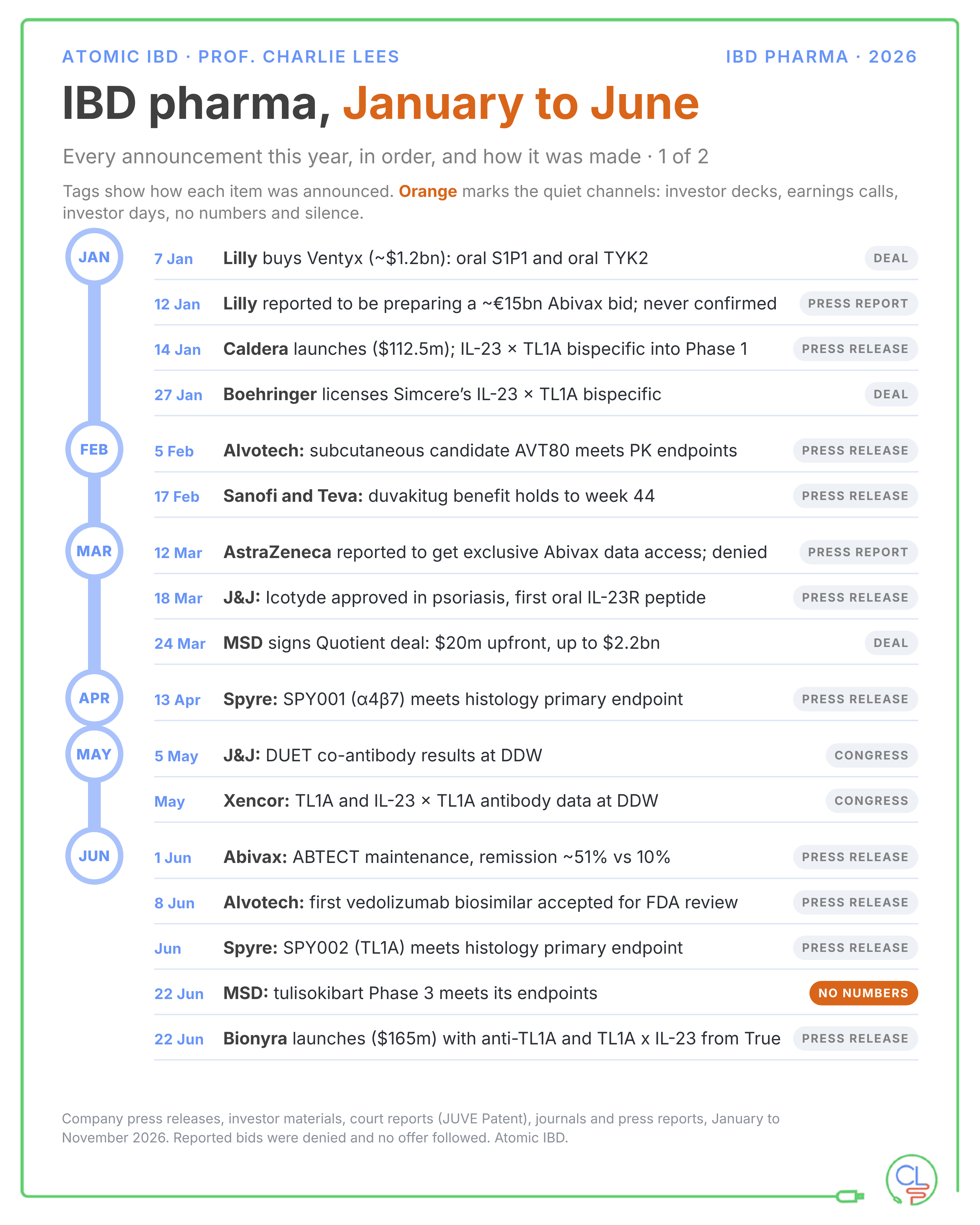
Next on Atomic IBD I’ll come back to this year’s translational papers: PROFILE at five years, the Nature Medicine response trajectories, and the IL-10 autoantibodies in the NEJM.
Everything here comes from company press releases, investor materials, court reports, journals and trial registries, linked above. Reported bids were denied and no offer followed. Where a company has not published numbers, I have not guessed them.
Discussion about this post