


This is Part two of this series on combination therapy in IBD. Part 1 covered two advanced therapies given together as injections. This one is about tablets: the new oral medicines, why getting them licensed won’t be enough, and whether an IBD polypill is realistic.
On 22 October Gilead agreed to pay $1.275bn upfront for HCXT-2001, an oral IL-23 receptor peptide still in Phase 1. Its chief medical officer, Dietmar Berger, was clear about why: “We see potential for HCXT-2001 alone or in combination, including with emvistegrast, as a daily oral treatment for people living with IBD.” Emvistegrast is Gilead’s own oral α4β7, and it had positive Phase 2 data at UEG this month.
Gilead has done this before. In hepatitis C it bought sofosbuvir, then put it in one tablet with a second antiviral (Harvoni), then a different partner (Epclusa), then two (Vosevi). Cure rates went from around half with interferon to more than 95%. In HIV it led the move to single-tablet regimens, starting with Atripla in 2006.
J&J has made the opposite bet. Its combination is two antibodies in one subcutaneous injection, JNJ-4804, and none of its trials pairs its own oral IL-23 receptor peptide, icotrokinra, with anything. It doesn’t think it needs to. In April its chief executive, Joaquin Duato, told investors that icotrokinra (Icotyde) “has the potential to be one of our largest products ever”.
So who’s right? For icotrokinra, in the US, J&J may well be: an IL-23 receptor blocker in a tablet, already licensed in psoriasis. But how many others can say the same, even in the US? My view: the new tablets will be licensed on their own. But outside the US, most of them will only be worth paying for in combination. And an IBD polypill? Yes, but not soon. Two tablets taken together will come first; one tablet holding both is harder than it sounds.
Three kinds of tablet
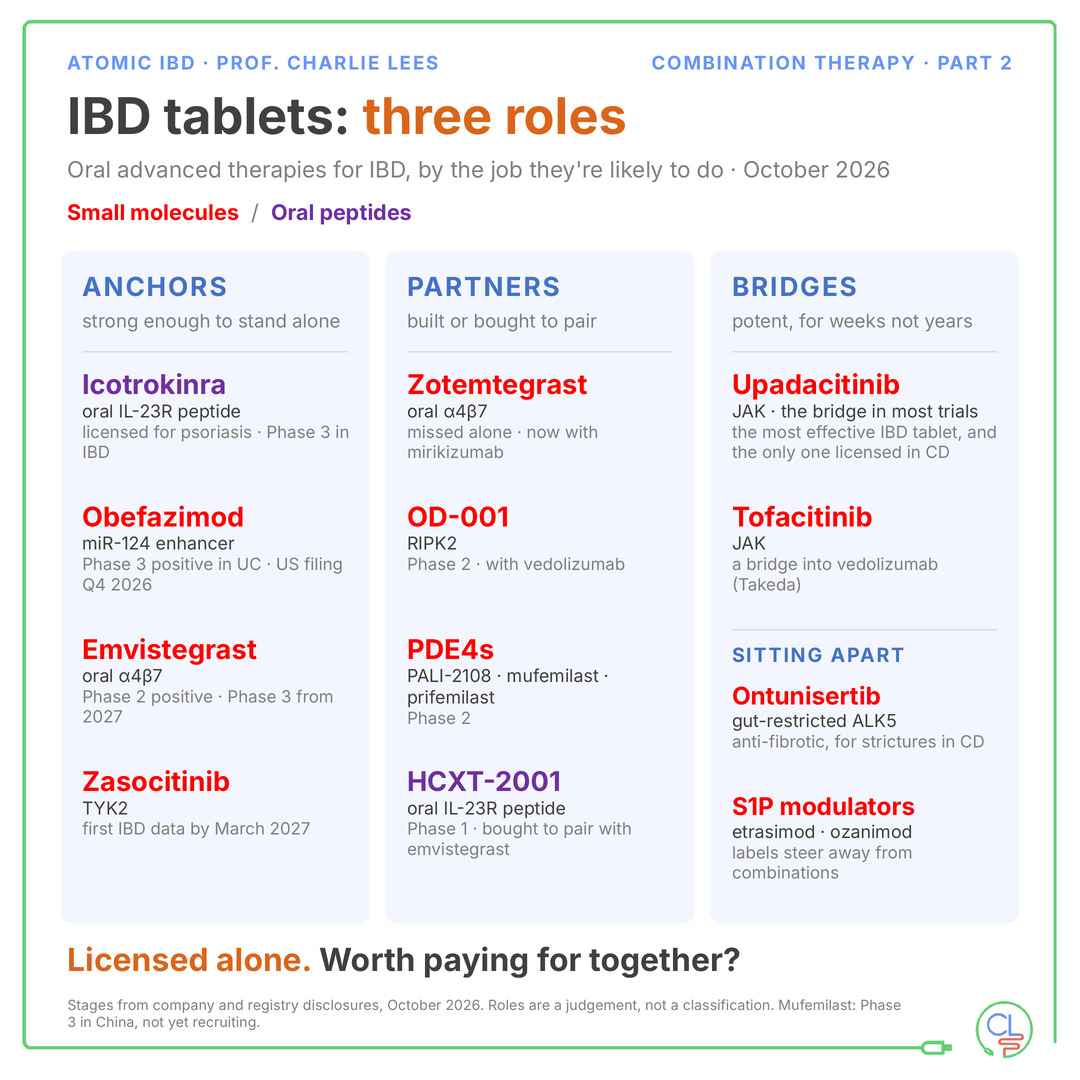
Not every oral medicine in the pipeline is heading to the same place. I’d put them in three groups.
Anchors are strong enough to stand alone. Icotrokinra is already licensed for psoriasis and is in Phase 3 in UC and CD. Obefazimod has positive Phase 3 results in UC and a US filing due by the end of the year. Gilead plans a monotherapy Phase 3 of emvistegrast in 2027 while calling it a “potential backbone for future combination approaches”.
Partners are built or bought to pair. Gilead bought HCXT-2001 to pair with emvistegrast. Lilly’s oral α4β7, zotemtegrast, missed on its own and is now being tested with mirikizumab. Odyssey pitches OD-001, an oral RIPK2 inhibitor, as “a monotherapy and backbone for combination regimens”.
Bridges are potent tablets used for weeks, not years, while something slower takes over. Upadacitinib is the bridge in most of today’s combination trials.
Two sit apart: ontunisertib, an anti-fibrotic for stricturing CD, and the S1P modulators, whose labels steer away from combinations.
On effect size, the leading new orals beat placebo by about 13 to 23 points in UC induction trials, roughly what modern biologics achieve. They widen choice. They don’t break the ceiling.
Licensed isn’t the same as used
Getting a drug licensed means beating placebo. Getting it used means beating what we already have, at the price we already pay.
By the time most of these tablets launch, in the early 2030s, the competition is cheap:
Filgotinib’s main patent runs to about 2030, and upadacitinib’s US composition-of-matter patent to 2033.
Ustekinumab is already biosimilar, and vedolizumab follows from 2027.
Guselkumab’s main US patent ends in 2031, with several biosimilars in development.
We know how fast the NHS moves: biosimilars replaced 86% of Stelara use within eight months.
So picture a new tablet that beats placebo by 25 points on every endpoint, with a clean safety record, launching in 2031 at a branded price. Why would a UK payer choose it over a generic JAK or a biosimilar IL-23 at a fraction of the cost, if efficacy and safety are much the same? My guess is that NICE says yes at a confidential discount, and local formularies put it behind the cheap options. Convenience alone won’t carry a six- to tenfold price.
The honest counter is that UK prices aren’t list prices. A company can choose to discount close to biosimilar levels, and then convenience does win.
America is different, and that’s why icotrokinra is the big bet. AbbVie’s settlements keep generic upadacitinib out of the US until April 2037, and icotrokinra already has scale in psoriasis. J&J can win there with a single tablet.
Obefazimod has the opposite problem. Abivax’s own annual report says its composition-of-matter patents expire in 2030 and its method-of-use patents in 2035, and calls that “a risk to its successful commercialization”. A combination tablet could carry new patent protection well into the 2040s. For obefazimod, the clinical case for combining and the commercial case point the same way.
The cheap pair is already here
There’s a catch. Clinicians already build combinations from drugs that are getting cheaper, off licence, for the people who need them most.
We do it in Edinburgh. More than 80% of the advanced combination therapy in my clinic is for refractory Crohn’s disease. In April we published our first 15 patients on upadacitinib with risankizumab, with a median of three advanced therapies already behind them. 53% had a steroid-free clinical response at 12 weeks, with no treatment-related serious adverse events. We’ve used it in many more since, including with guselkumab, alongside IL-23 inhibitors with vedolizumab and some adalimumab with ustekinumab. One of our fellows is pulling all of that together now, and it’s the basis for Part 3.
As the parts go generic and biosimilar, the do-it-yourself pair gets cheaper still. That’s the real benchmark for any branded combination. To beat it, a branded pair needs what the DIY version lacks: trials, set doses, a long-term profile clean enough for earlier use, and the simplicity of one tablet.
A word on JAK inhibitors, because I don’t want to worry anyone taking one. Long-term use is common in UC and CD, and most people do well. What stops a JAK plus a biologic being everyone’s long-term treatment is something else:
Rinvoq’s label says it isn’t recommended with biologics.
The EU restricted JAK use in people with certain risk factors in 2023.
There are no long-term data on the pair.
That’s why we use these pairs selectively.
If upadacitinib is the bridge, filgotinib could be the drug you stay on: enough for many people with moderate UC, and the only JAK inhibitor without a significant rise in shingles in Shahida Din and Alex Ford’s meta-analysis. As a generic from around 2030, it could be the long-term half of a do-it-yourself pair.
Four ways to add a tablet
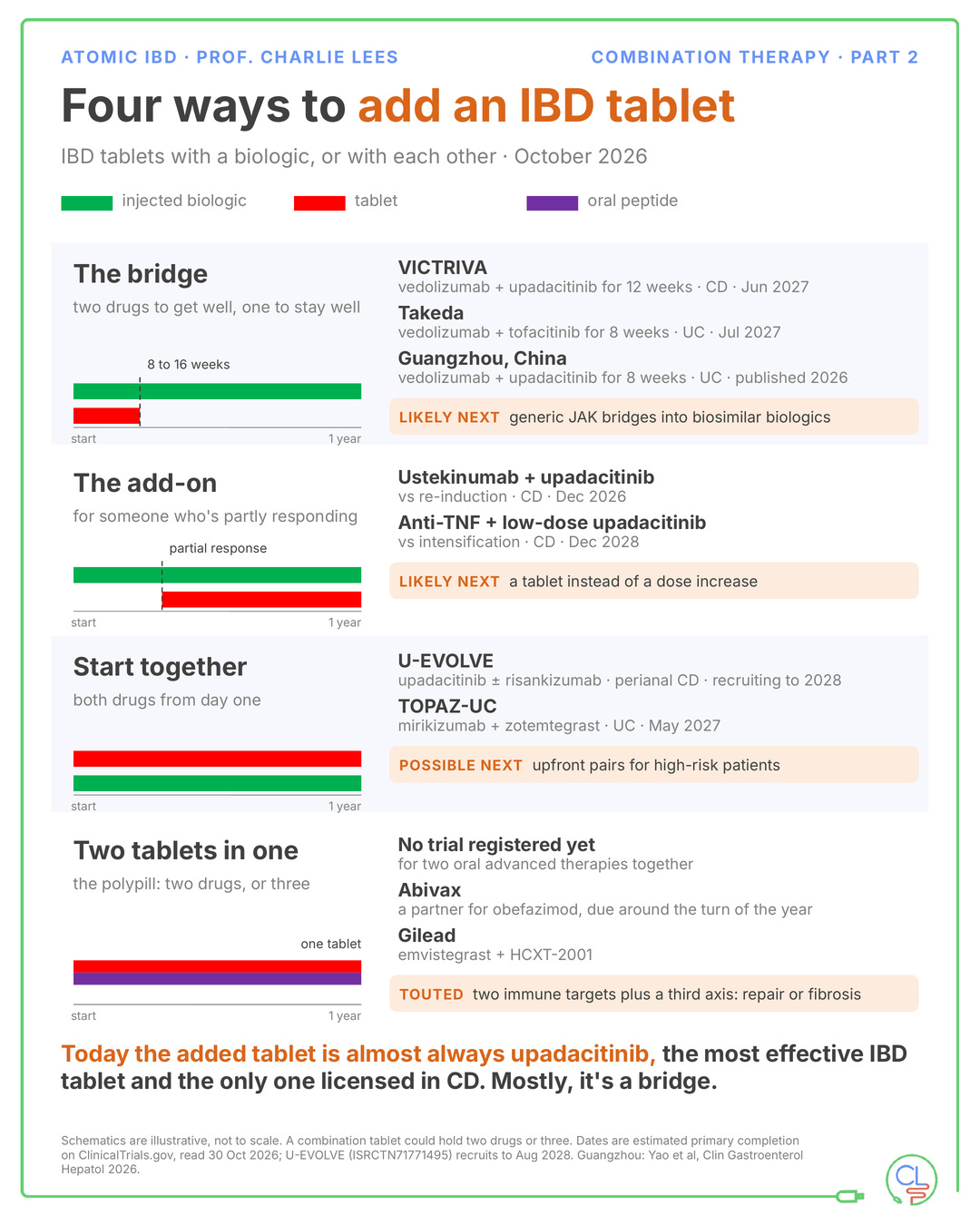
The bridge: two drugs to get well, one to stay well. Upadacitinib is made for this. It’s a drug like no other in IBD. It’s the one I reach for in a sick outpatient with UC, often to keep someone out of hospital. It’s used increasingly in acute severe colitis too, which the UK ACESO trial is now testing properly. But in CD some people lose ground after the 12-week induction course, and the maintenance doses don’t always hold them. For many, I think upadacitinib’s future is as an 8- to 16-week bridge into something that keeps them in deep remission.
VICTRIVA tests exactly that: vedolizumab plus 12 weeks of upadacitinib in CD (primary completion June 2027).
Takeda is testing a tofacitinib bridge into vedolizumab in UC.
An academic trial in Guangzhou, China, has already added 8 weeks of upadacitinib to vedolizumab in UC: endoscopic remission 37.5% v 15.1% at week 8. It was open label and stopped early, which tends to overstate benefit, but it’s a striking result.
The add-on: for a partial response. This is such a common clinical scenario, and such a hard call, that it gets its own piece: Part 3.
Start together: both drugs from day one. This makes most sense where the stakes are high from the start, and perianal fistulising CD, a distinct sub-phenotype, is the clearest case.
U-EVOLVE, led by Imperial and funded by AbbVie, randomises 160 people with perianal fistulising CD to upadacitinib alone or upadacitinib with risankizumab, open label, and judges clinical and MRI response at week 24, with the MRI read blind. There’s a lot of excitement about upadacitinib as the drug to hit fistulas, so it’s the backbone. Risankizumab goes on top because we know it well, it works, and on its own its safety record is clean. IL-23 now has its own fistula data too: in FUZION CD, guselkumab more than doubled combined fistula remission at week 24 (28% v 10%). No other trial is testing this pair in fistulas, which makes U-EVOLVE more important than its size suggests. I suspect it won’t be the last.
In TOPAZ-UC, Lilly adds zotemtegrast to mirikizumab, then re-randomises responders to see whether both drugs are needed to keep people well.
Two tablets in one. No trial of two oral advanced therapies together is registered yet. Abivax plans to choose a combination partner for obefazimod around the turn of the year, and Gilead now has its pair.
Follow the maintenance drug
When two companies’ drugs are paired, look at which one patients keep.
Takeda’s trials: in VICTRIVA and Takeda’s tofacitinib study, Takeda keeps its vedolizumab and the other company’s JAK is the bridge.
Odyssey’s trial does the reverse: OD-001 with vedolizumab for 12 weeks, then OD-001 alone. That turns the logic of a bridge upside down, dropping the slow, safe, gut-selective antibody to keep the new tablet. Biology might keep the vedolizumab. Ownership keeps the OD-001.
And notice the trials nobody is running. J&J isn’t pairing icotrokinra with anything. AbbVie owns both upadacitinib and risankizumab, and the only randomised trial of the two together, U-EVOLVE, is academic-led, with AbbVie funding. I doubt it stays that way.
Is an IBD polypill realistic?
Part 1 promised an answer, and I’ve given mine: yes, but not soon. Here’s why.
The rules don’t forbid it. They ask each drug in a combination to show that it contributes, which for three drugs means big, complicated trials. The realistic path is the one Gilead took in hepatitis C: get a pair licensed, then add the third.
The chemistry is harder than it looks. Two small molecules go into one tablet easily, as the HIV regimens show. I can’t find an approved tablet that combines an oral peptide with a small molecule, and icotrokinra shows why. It’s a 200 mg tablet, taken on waking on an empty stomach, with nothing to eat for 30 minutes; a high-fat meal cuts exposure by about 40%. Very little is absorbed (0.1 to 0.3% in animals), and up to 80% of the dose comes out unchanged in the stool. It’s formulated without an absorption enhancer. Oral semaglutide needs one, tailored to that single drug.
Put a second drug in the same tablet and the problems stack up:
Absorption. Peptide absorption is fragile. With oral semaglutide, just swallowing five placebo tablets at the same time cut absorption by about a third.
Timing and place. A peptide taken fasting on waking doesn’t suit a partner that needs food, or one built to release in the colon.
Proof. Regulators want the combined tablet to behave like the two drugs taken separately. That’s hard to show when peak icotrokinra levels vary by around a third from dose to dose in the same person.
None of this is impossible. But it’s a reason two tablets taken together may come before one.
Why hepatitis C flatters the comparison
It was a cure after 8 to 12 weeks, so a high price was paid once. IBD is treated for life.
Antivirals hit separate viral proteins and block resistance. IBD is a varied immune disease.
The arithmetic changes with the patient.
In harder-to-treat disease, doubling is already showing up: 49% v 27% in DUET-CD after two or more failed classes, and 41% v 22% in TARGET-CD.
In early disease, good single drugs already put most people into clinical remission (65% and 61% at a year in SEAVUE), so the honest target is endoscopic remission, where the best single drugs rarely get much past a third. Doubling that is the bar.
EXPLORER is a caution, not a verdict. Three drugs (vedolizumab, adalimumab and methotrexate) in newly diagnosed high-risk CD gave 34.5% endoscopic remission at week 26. It was small, open label and single arm, and probably not the combination you’d choose for CD today. What it does show is that stacking drugs isn’t enough on its own. The targets matter.
Where this ends
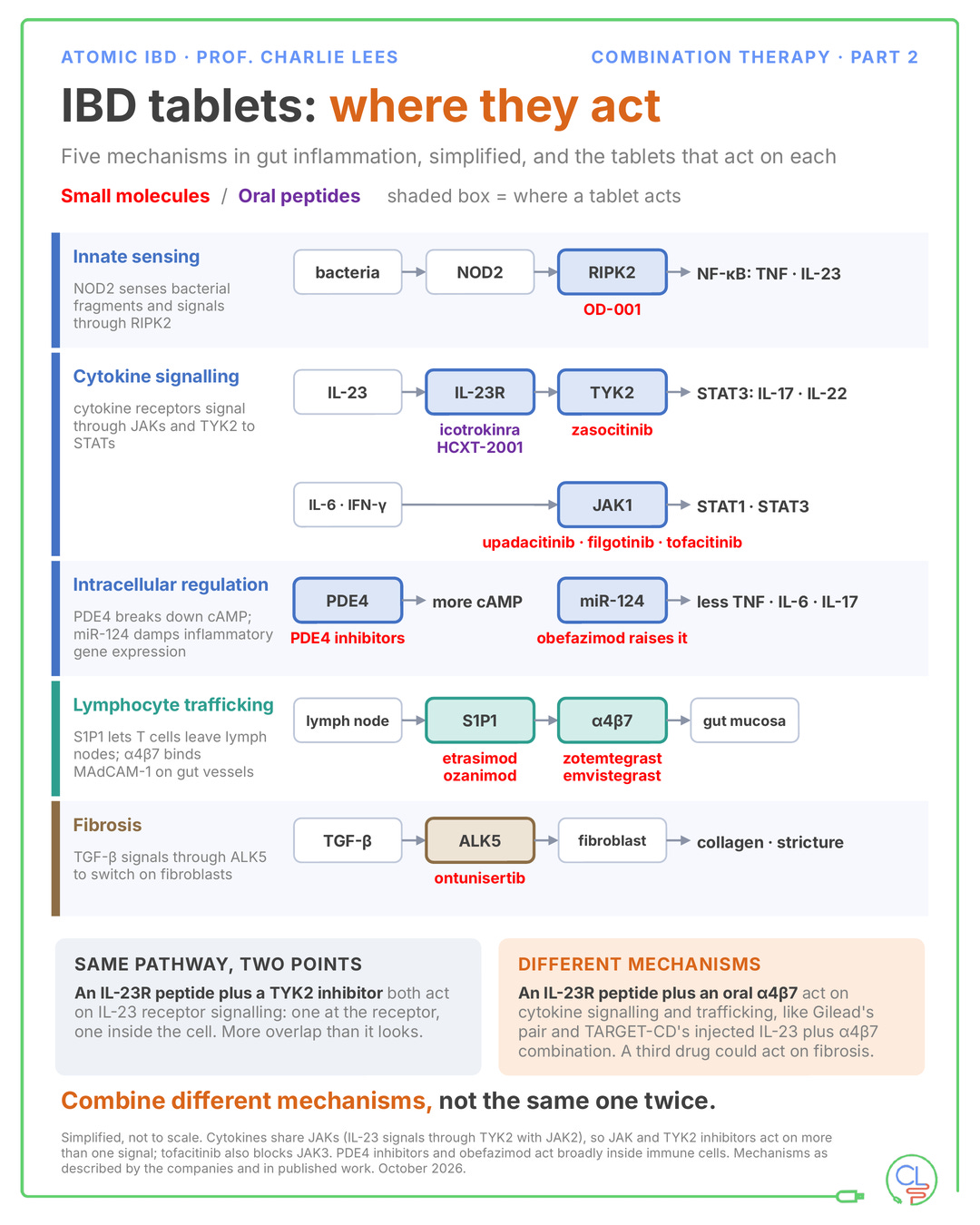
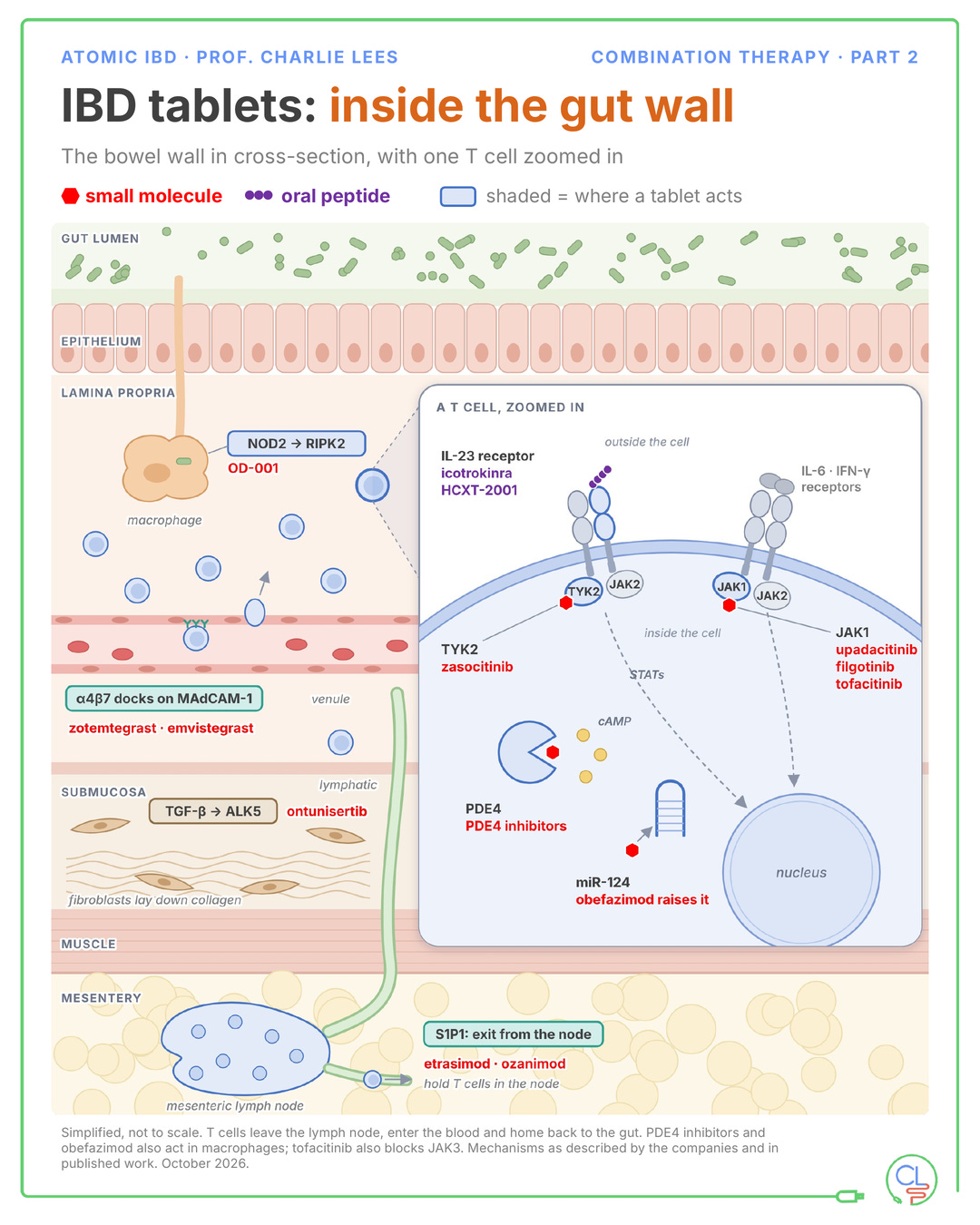
If an IBD polypill comes, I don’t think it will be three drugs doing the same thing. It will be two complementary immune targets, an oral IL-23 receptor blocker with an oral α4β7, say, plus a third that works on something different: healing the lining, stopping scarring, or turning down several inflammatory signals at once, as obefazimod is thought to do by raising miR-124. That’s how you might double the hardest endpoints without just piling on more of the same.
For now, the action is in refractory patients: the bridge, and the do-it-yourself pair. In the 2030s it could be a two- or three-drug tablet for people newly diagnosed and heading for a tough course. That’s who I’d most like to give it to.
What to watch:
Abivax’s combination partner: around the turn of the year
Zasocitinib in UC and CD: by March 2027
TOPAZ-UC: primary completion May 2027
VICTRIVA and Takeda’s tofacitinib bridge: June and July 2027
OD-001 with vedolizumab: second half of 2027
Emvistegrast Phase 3: starts 2027
ICONIC-UC (icotrokinra): primary completion January 2028
Next, Part 3: advanced combination therapy in IBD, what I actually do in clinic, and the hardest call of all, a partial response: switch or add?
Introducing EdinburghIBD.com
Writing the next decade of IBD care
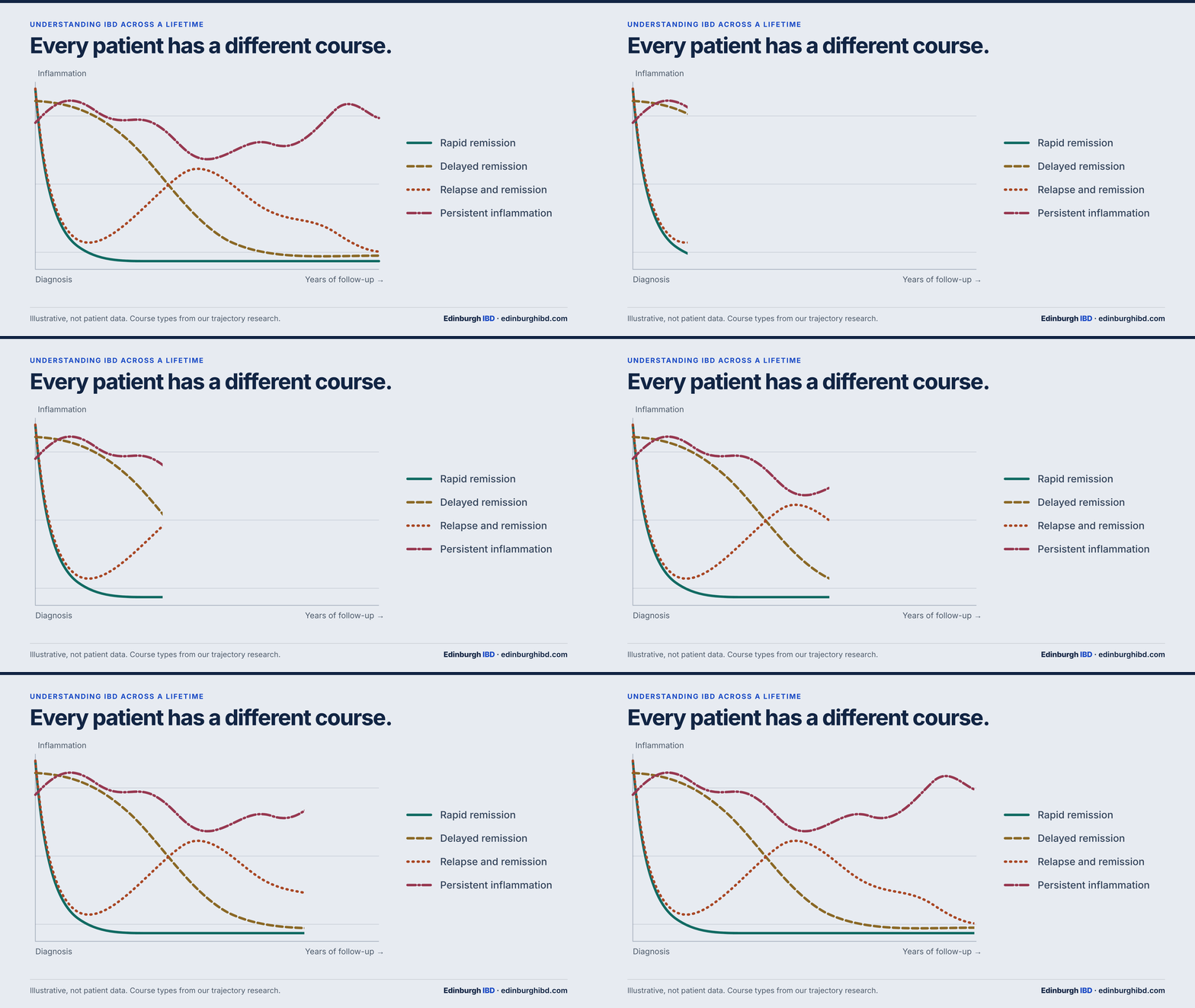
Advanced combination therapy gives us a way to break through the therapeutic ceiling in IBD, but getting it right in clinic depends on answering two harder questions: which patients are on an inflammatory trajectory that justifies early dual therapy, and how do we monitor them closely enough once they reach remission?
We recently launched EdinburghIBD.com—one home for our integrated research and clinical team at the University of Edinburgh and NHS Lothian, built around those exact questions:
The Data Foundations: Over 20 years of real-world follow-up in the Lothian IBD Registry (~10,000 patients, fully integrated with Dataloch) alongside the UK-wide PREdiCCt cohort (2,629 participants across 47 sites).
Four Research Programmes: Longitude (modelling inflammatory trajectories over time), Vantage (population-level clinical observability), Continuum (diet, microbiome, and whole-person health), and Cairn (built with patients).
SENTINEL (Our Flagship Platform): Clinician-supervised decision support and proactive monitoring designed to make the space between appointments safer and the next clinic conversation more useful.
Clinical Trials & Publications: Plain-language summaries of our 166 papers and details on 10 actively recruiting clinical trials: including new molecules, combination strategies, and intestinal ultrasound studies.
Whether you are a clinician, researcher, prospective fellow, or someone living with IBD, take a look around, and let me know what you think.
To make a donation towards our research programme click here.
What a great summary. Thank you Charlie so much.